

It’s Peak Season for Witch Hazel
by Linda Nordstrom, FROGS Board Member and Green Spring Extension Master Gardener
Zip up those coats, pull on your hat and gloves and head out for a walk at Green Spring Gardens. The witch hazels are in season! The camellias have graced the garden with blooms since October, and now it is the witch hazels’ turn.
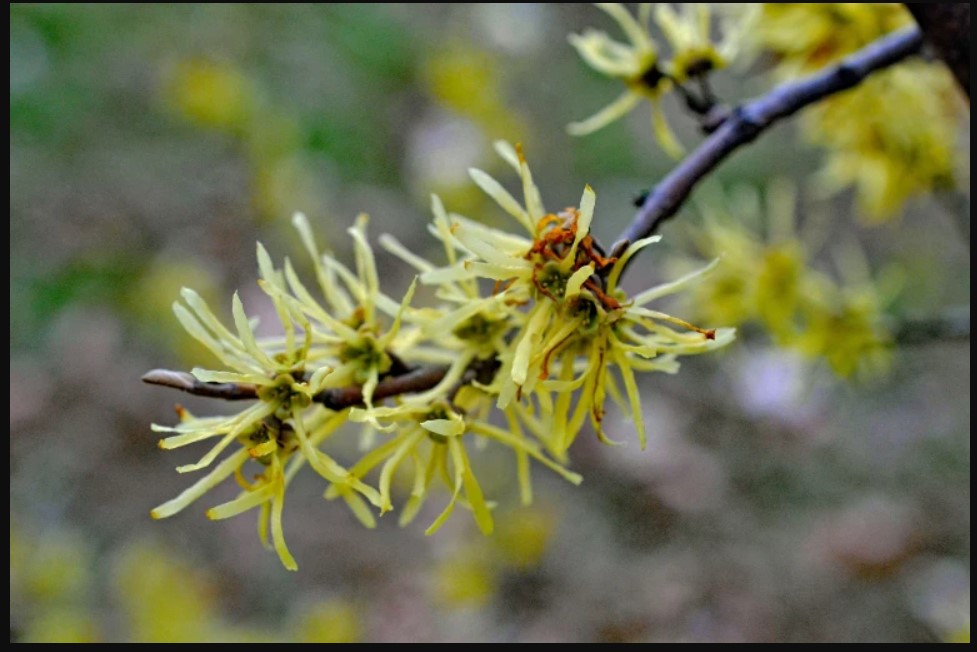 Green Spring Gardens is home to 200+ specimens of this beautiful shrub and is one of only three American Public Gardens Association Plant Collections Network (PCN) collections focused on Hamamelis (H) in the United States. Our witch hazel collection consists of mostly hybrids and cultivars of North American and Asian species.
Our Virginia native witch hazel, the Hamamelis virginiana, is an autumn bloomer. Its yellow flowers have a citrus smell, but you will need to catch this one next fall.
Most witch hazels bloom for weeks in winter and early spring. When the weather is very cold, the blooms curl into themselves and await a warmer day. On those warmer days, the blooms unfurl, and, with some, their fragrance fills the air. Not all witch hazels bloom at the same time, so there is always a chance of catching a few in bloom throughout February and March.
Witch hazels can be found throughout the gardens. Maps of the garden can be found in the Horticulture Center, at a walkway entrance near the Historic House in the parking lot, and near the large oak tree in the circle. The red lines on the map (shown below) indicate three of the paths to walk.
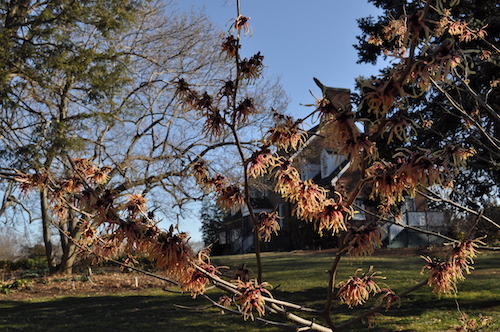 Some witch hazels are vase-shaped and others have horizontal branching that in some species can spread to 15 feet. Their variety of colors gives Northern Virginia’s drab wintertime a surprising look. You can view a short video along with more about the collection on Green Spring Gardens website. Now, let’s go for that walk.
The Entrance Garden that you drive past as you come into the parking area has the most witch hazels. This garden on both sides of the path and across the road has over 100 specimens in several hues of predominantly yellows, oranges, and reds. The purple blossoms here will also catch your eye for their unusual color. H ovalis (Mississippi native), H intermedia (a cross between Japanese and Chinese witch hazels), as well as cultivars of H mollis (Chinese witch hazel), H vernalis (native Ozark witch hazel), and H virginiana are predominant in this garden.
Continue your walk from the first stop sign at the parking lot, toward the Historic House. At the intersection of the driveways, turn right, and there is a beautiful horizontal-shaped witch hazel on the left corner. This “standout” blooms a stunning yellow-orange that can’t be missed when in full bloom.
Walk up the driveway and turn left at the first parking space. Walk into the grass and head straight toward the Spring House Overlook. Notice all the witch hazels in the beds in this area. Hellebores and spring ephemerals bloom happily beneath them. When you reach the Spring House Overlook, you will see nearly a dozen shrubs, including different cultivar specimens of those listed for the Entrance Garden, as well as H japonica (Japanese).
After this excursion off the path to the Spring House Overlook, come back to the path and continue throughout the gardens, which are sprinkled with more witch hazels. As you head back to your car, be sure to walk the path from the Horticulture Center along the parking lot. This area, called the Long Border, has witch hazels peppered throughout. Glance across the parking lot to the Screening Garden for “pops of color” along the brick wall.
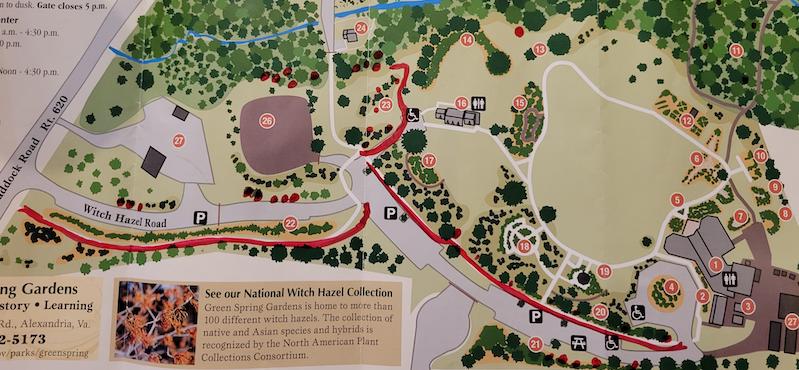 Green Spring map showing the location of Witch Hazels (in red line)
We hope you enjoyed your witch hazel journey through the gardens. Come back often!
All photos were taken by Linda Nordstrom.