
 Fall 2019The Beautiful London Plane Tree
by Gil Medeiros
When is an American sycamore not a sycamore? Answer: when it is a London plane tree. Wait … what? And what does that have to do with Green Spring?
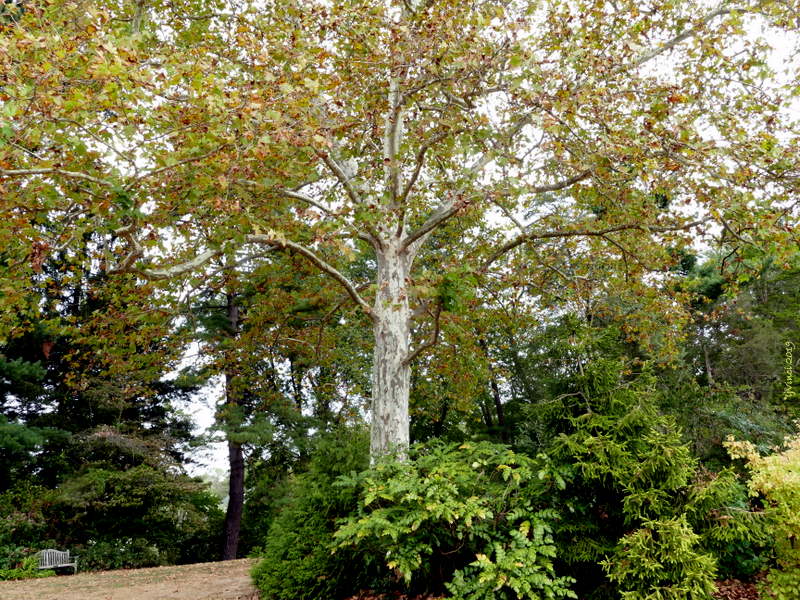 Green Spring’s magnificent London plane tree. This photo looks to the north from the brick path. (Photo credit: Lois Vinci)
Green Spring has a very prominent London plane tree, which strongly resembles an American sycamore but is not. The plane tree provides shade to a quintessential picnic spot just north of the brick pathway not far from the Historic House. You have probably admired this tree many times.
The London plane tree is a close cousin to the American sycamore. It is, in fact, a hybrid between the American sycamore (Platanus occidentalis) and the Asian sycamore (Platanus orientalis). The result is Platanus x acerfolia, aka the London plane tree. It stands astride the botanical intersection of east and west.
 Close-up view of the trunk of our London plane tree. This feature is a key identification point for all plane trees. (Photo credit: Lois Vinci)
The American sycamore is a large stately native tree with distinctive mottled brown and white bark that exfoliates throughout the year. It is strikingly beautiful; however, it has a major problem as a specimen in a park or a backyard. It is highly susceptible to the fungal disease anthracnose.
Anthracnose (Apiognomonia veneta), though not usually fatal, is a big deal for a sycamore. The fungus causes over 90% of the leaves to wither, turn brown, and fall away during the spring when daytime temperatures reach 50 to 55 degrees F. The tree normally produces a second growth of leaves when the temperature warms, but is unsightly and messy during a period when it is expected to radiate beauty, and the same thing happens year after year.
Enter the London plane tree hybrid. Some cultivars are highly resistant to anthracnose. This is the much preferred specimen for a backyard or park. Also, some London plane tree cultivars grow to lesser height than the American sycamore, making them a much more friendly choice for the backyard of limited size. ‘Liberty’ and ‘Columbia,’ two cultivars introduced by the National Arboretum in 1984, are suitable for home planting.
The London plane tree is also resistant to various forms of pollution. With its characteristic tolerance of various soil types it has become a ubiquitous urban tree in settings such as London, Paris, and New York.
Platanus, the genus name for the sycamore and the plane tree, is derived from the Greek platys, which means “broad.”This refers to the width of the leaves, which have a similar shape to those of the maple but are much wider.
How do the words “American” and “Asian” combine to make something that has “London” in its common name? The earliest specimens of London plane tree were discovered in the seventeenth century at Vauxhall Gardens in London by botanist John Tradescant the Younger. The London plane tree was determined to be a hybrid that formed—for the first time and quite by accident—from American and Asian sycamores that had been planted in close proximity in a collection garden. (Note: history is an imperfect science. There is a competing narrative that claims the London plane tree was actually discovered in Spain at about the same time.)
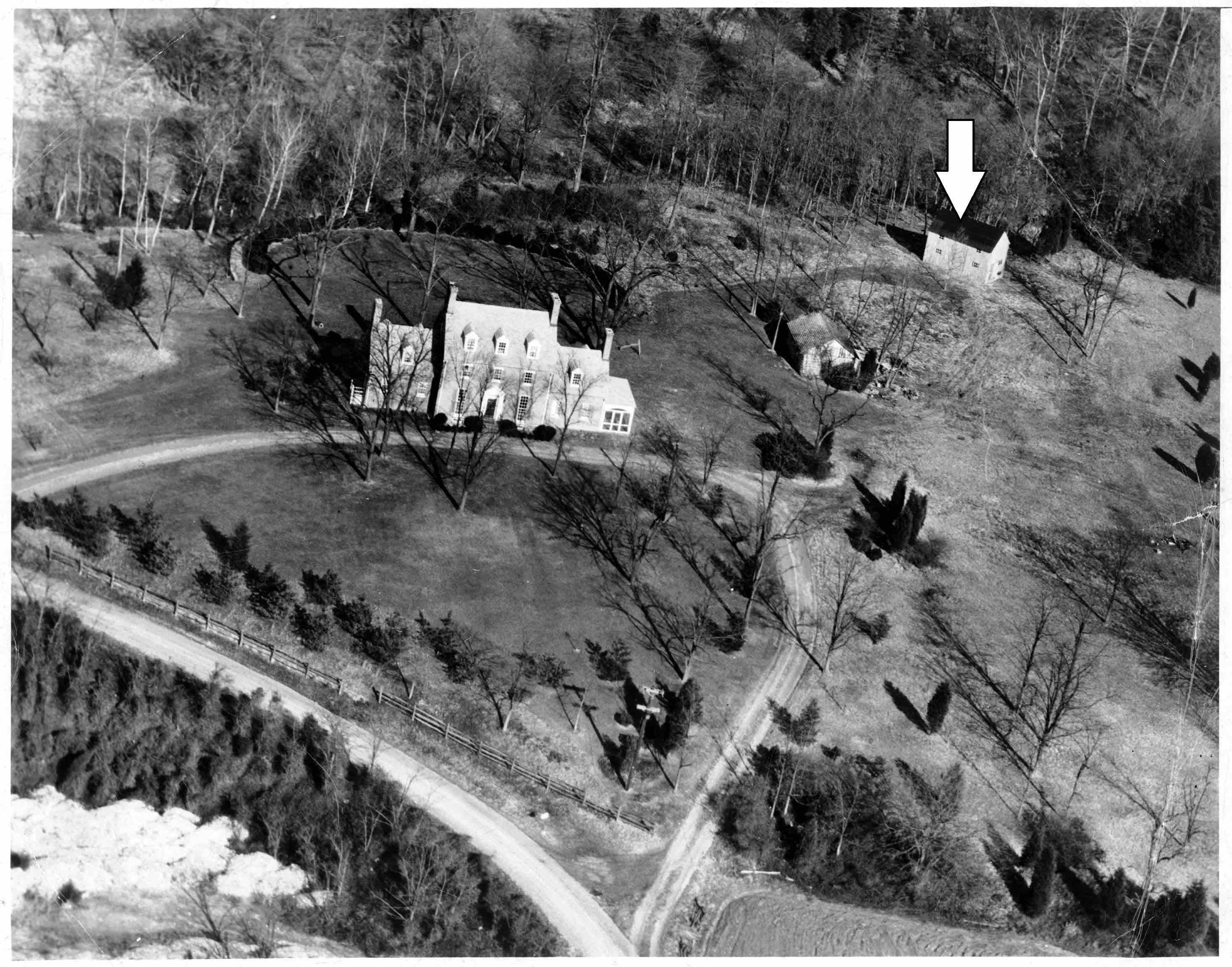 This 1948 aerial shot shows the London plane tree near the old barn. (Photo credit: Fairfax County Park Authority Archives)
This tree looks as if it has been at Green Spring forever. Of course it hasn’t, but there is no extant record of its planting. However, Gardenline has consulted John Quast, Jr., son of the caretaker/groundskeeper for the Straight family. Quast’s family took residence at Green Spring Farm in 1942. He recalls that it was already a well-established tree when his family began their tenure at the farm.
Based on this data point and photographs from the archives, we estimate it was most likely planted during the time Minnie Whitsell owned the farm; Whitsell bought it in 1931. That would mean the tree has been in place for approximately 85 to 88 years. It was likely planted to either shade the adjacent barn or simply add a new and appealing specimen to the grounds. Barring unusual insect or disease problems, the specimen could easily live another 85 years.
In 2017 a plaque was installed near the base of the tree to memorialize Ute Danforth, a generous benefactor of Green Spring Gardens for many years.
Is there a better spot in Green Spring to spread a blanket, enjoy a picnic, and admire the beauty of the gardens?
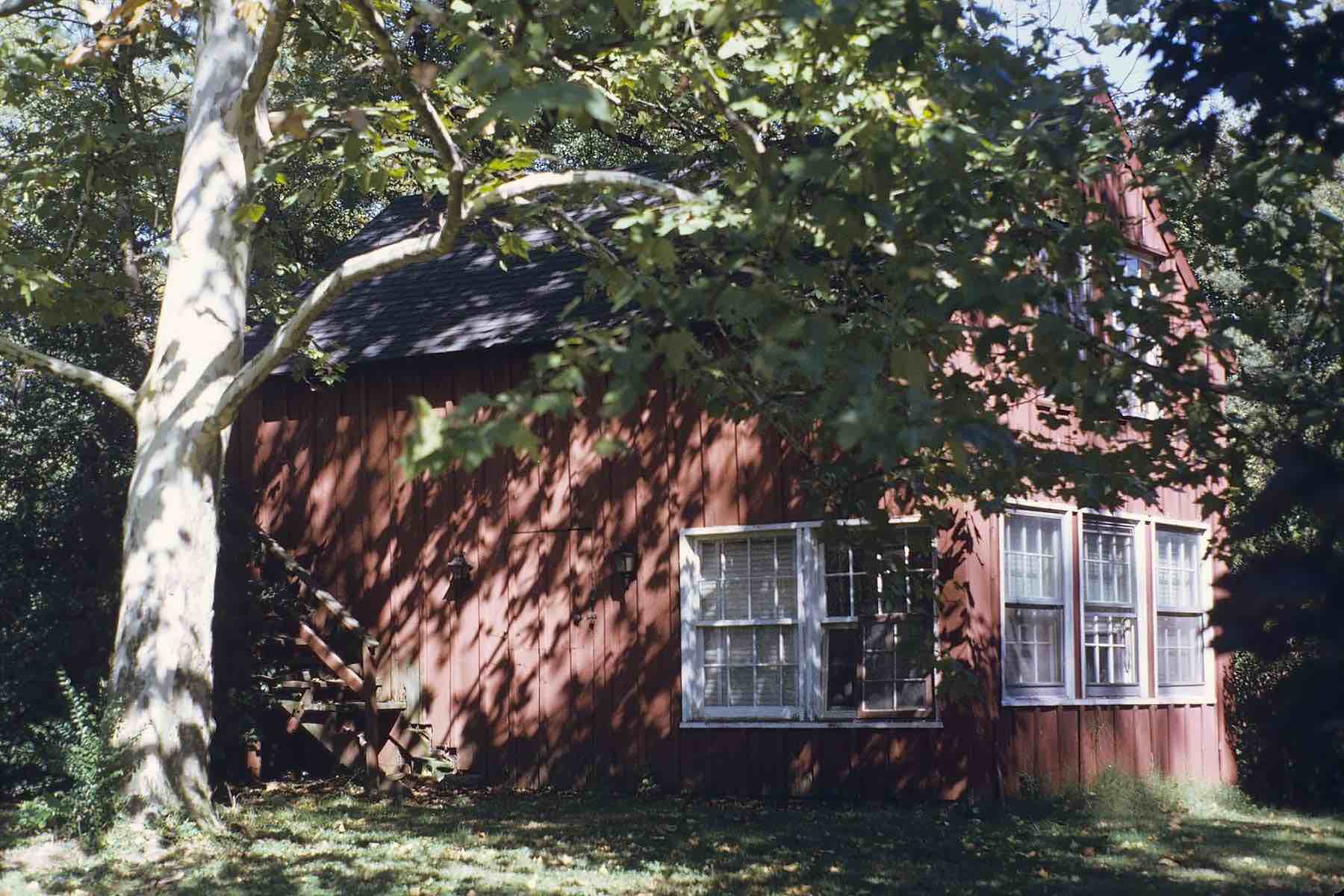 This photo from the 1950’s shows the London Plane tree and the old barn that was next to it. By the time of this photo the barn had been converted to maids quarters by the Straight family. The structure was removed before Green Spring Gardens was opened to the public. (Photo credit: Fairfax County Park Authority Archives)
