

Lost to Progress at Green Spring
by Debbie Waugh,
Green Spring Historian
Many structures that once stood on Green Spring Farm are long gone: an original brick kitchen, a servant’s house, meat house, blacksmith’s shop, wagon stand, and barns and stables were all listed in an 1831 sales advertisement for the farm.
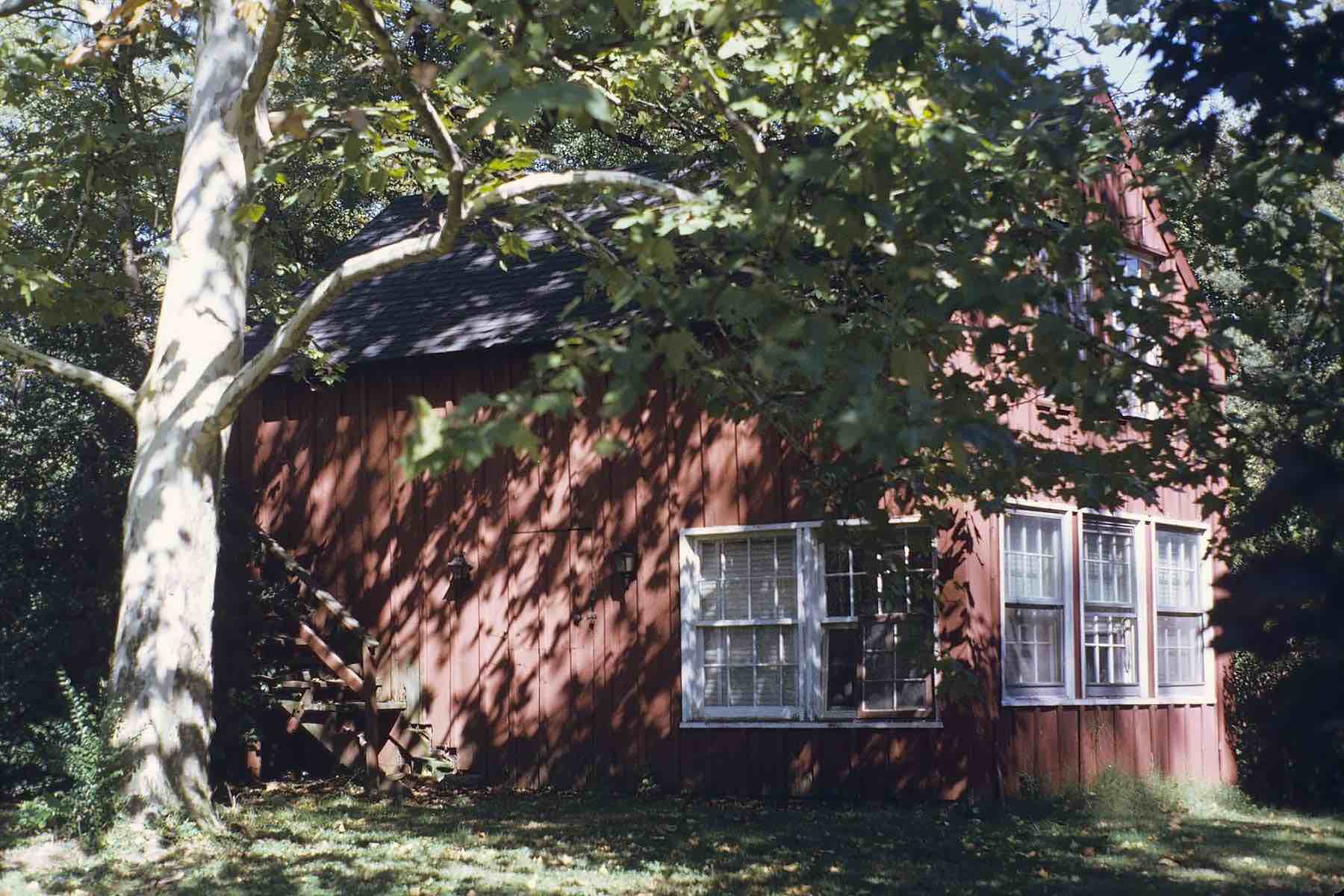 The Barn, circa 1950's. Photo credit: Fairfax County Park Authority ArchivesOther significant structures were lost after the Park Authority received the property from Michael and Belinda Straight in 1970, when the process of transforming a family estate into a public garden raised the question of what to do with the associated buildings. Should they be preserved, repurposed, or demolished?
Sadly, three buildings fell to the wrecking ball.
The Barn: A two-story barn stood 200 feet northeast of the Historic House. Its original construction date is unknown, but it was here when the Straights came to Green Spring in 1942. They converted it into a maid’s quarters, with a kitchen and laundry downstairs and living quarters upstairs, accessed by an exterior wooden stairway.
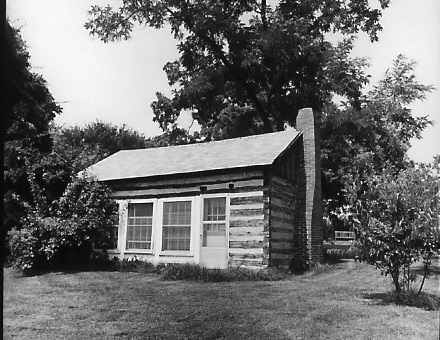 Log cabin, 1960s Photo: John AntinelloThe Log Cabin: Minnie Whitesell, who lived at Green Spring from 1931 to 1938, had a log cabin brought here from a mile away on Little River Turnpike towards Lincolnia. She used it for storage. Later, the Straights converted it into a guest house. Its origins are unknown but it is worth noting that, following the Civil War, Lincolnia became a community of freed slaves and remained one of Fairfax County’s original African American communities for one hundred years.
Like many historic structures, both barn and cabin were tangible connections to the past but had outlived their usefulness. By the mid-1970s, the Park Authority deemed them dilapidated beyond repair and tore them down.
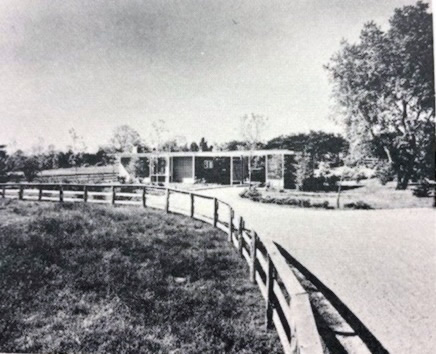 Tobey House approach from Little River Turnpike. Photo credit: Robert Lautman, c. 1960.The Tobey House: A small, modern, open-plan home set a little back from Little River Turnpike, was built for Belinda Straight’s mother, who lived there from 1954 to 1968. It won a 1958 design award from the American Institute of Architects and was featured in a two-page spread in House and Garden Magazine in 1959. But commercial rezoning of that section of Green Spring Farm placed the house in the middle of what would become the neighboring Ford’s auto dealership. Cue the wrecking ball.
Inevitably, bygone ancillary farming structures are lost to the sands of time and buildings fall to progress. Regrettably, these parts of Green Spring’s past are lost forever, but we will take great care to preserve our photographic records of them.
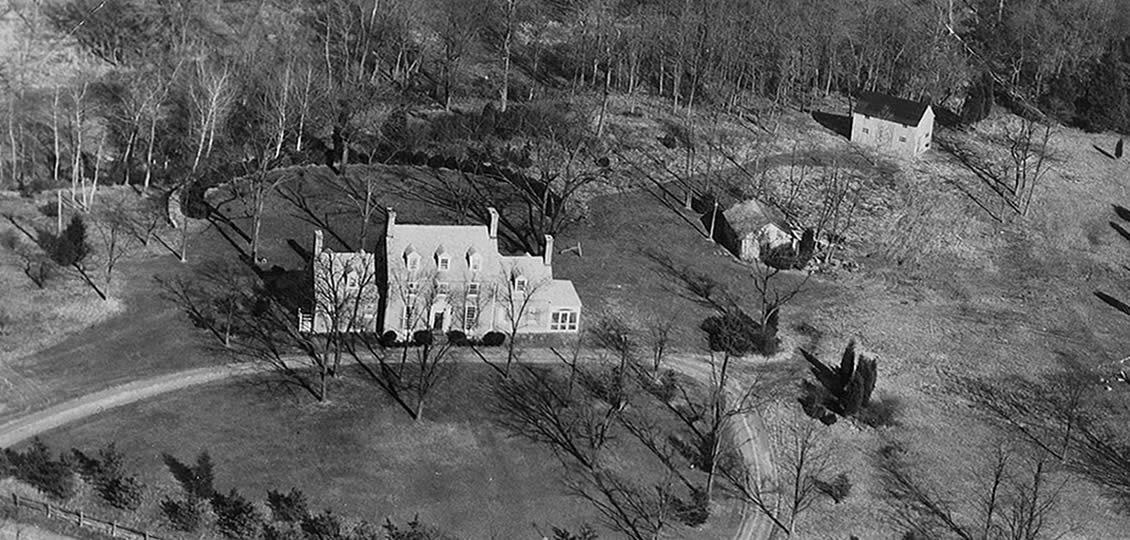 Aerial of house, barn and cabin before outbuildings’ renovation by Straights, 1948. Photo credit: Michael Straight
