
Container Gardening: Thinking Inside the Pot
by Cindy Brown,
Manager, Collections, Education & Access, Smithsonian Gardens
Living in an urban area has many benefits but owning a house with a big yard usually isn't one of them. Discouraging for a wannabe gardener perhaps, but instead of throwing in the trowel, why not bring bits of terra firma up to your level.
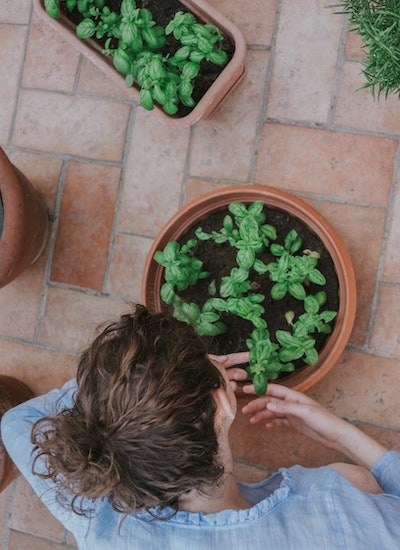 Basil plants in clay pots. Photo by Matteo Badini, pexels.com.Transform patios, balconies or rooftops into verdant acres, or at the very least, a few square feet of green. Evaluate the space available, consider its assets and limitations, and then think inside the box. Actually, think inside containers - all shapes, sizes and materials. Before dashing to the store to buy a passel of pots, let's develop a plan. All gardeners should analyze their site, make a list of wants and needs, and then determine what plants will both please the gardener and thrive in the existing conditions.
Edible plants should be on everyone's desirable list. Is there anything more worthy of a gardener's loving attention? When space counts, what is more appealing— a luscious, scarlet tomato or a hosta? But don't stop with the "love peach." All types of edibles can be grown in containers. The site's physical characteristics are the only limiting factors. Well almost— your budget is also a major factor. If matching Italian terra-cotta pots filled with figs, kale and cardoons are on your must list, you will be very fashionable, but your wallet will be much lighter.
Good looks and expense aren't the only considerations when choosing containers. How much weight can your deck, balcony, rooftop or back sustain? Before dragging numerous pots and filling them with heavy potting soil, find out your weight and strength limitations.
When you figure out how much weight your balcony and back can handle without stressing, don't forget to factor in the added water weight. A properly watered container could be twice the weight of a dry pot. Besides adding weight, consider what happens to the excess water. After all, when is the last time you watered a pot and all the water stayed contained? Will your deck withstand daily drenching? If you live in an apartment or condo the neighbors downstairs probably won't appreciate a daily waterfall. Even worse-what if the ceiling falls and you drop in with a salad mix for dinner? Apologies pardon some mistakes, but what kind of apology is necessary for a leaky ceiling? Will a bushel of zucchini be enough to express regrets?
Simple things surface gardeners barely consider may cause you to scratch your head pondering a solution. Even if you've considered what effect water will have on your structure, have you thought how you are going to provide water? Think about squeezing through a window, up the fire escape and around the rooftop air conditioner units. Carrying buckets from the kitchen sink to the balcony or rooftop is exhausting. One trip would never be enough. Multiple trips, every day, 150 days a year-how committed are you to fresh basil? Even dragging a hose can be exhausting. After a week of watering, you'll want to simplify the process. If you grow only ornamental plants you could choose sedums, cacti, succulents and other drought tolerant plants, but there are very few edibles that don't need a constant supply of water. Don't despair. Before you start lifting weights to get into water hauling shape, there are options available; expandable hoses or an adapted hydroponics system could offer relief.
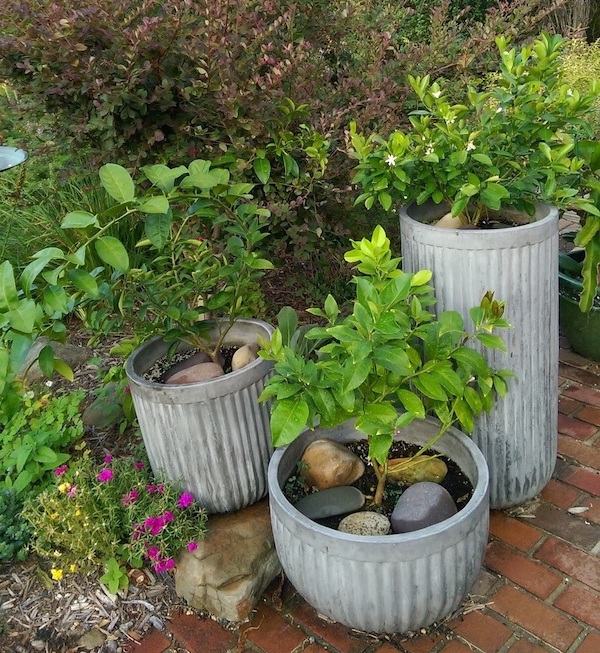 Grouping of planted containers on a brick patio. Photo by Debbie Waugh.Plant roots need something to cozy down into, providing them with nutrients and stability. What's going into your pots? Most bagged soil mixes are too light to withstand windy conditions; they dry out quickly, requiring additional watering duties. Besides increasing watering demands, unadulterated potting soil doesn't hold nutrients as efficiently as garden soil. Adding compost to the mix will help hold nutrients, slow down desiccation and provide extra weight for stability- but how is a container gardener going to make compost? Even more important, what are you going to do with all the debris generated when gardening? You could collect clippings in a garbage can. To prevent anaerobic, smelly conditions make sure holes are drilled in the bottom for drainage. To prevent the drippings from oozing directly onto the deck or patio, put the garbage can in a saucer. Then the drippings can be captured and mixed with water for homemade fertilizer. If you must remove clippings because a compost bin isn't feasible, investigate green possibilities. How about a community compost bin? Vermiculture is another option. Vermiculture is a form of composting which uses red-wriggler worms to help decompose kitchen and garden waste. It has a devout following in apartment dwellers. Think of it as having pets that don't need to be walked, taken to the vet or brushed. Best of all, the wiggly pets will supply your vegetable garden with free nutrients.
Fertilizing container grown plants is a must even if you have compost in your potting mix. Compost is great for the soil texture, but it isn't high in nutrients. Frequent watering moves nutrients through the soil quickly; it is important to provide plants with a steady supply of nutrients. Organic fertilizers such as fish emulsion or liquid kelp are stellar choices, but synthetic fertilizers are also acceptable. An application every other week is ideal, but an occasional feeding is better than none at all.
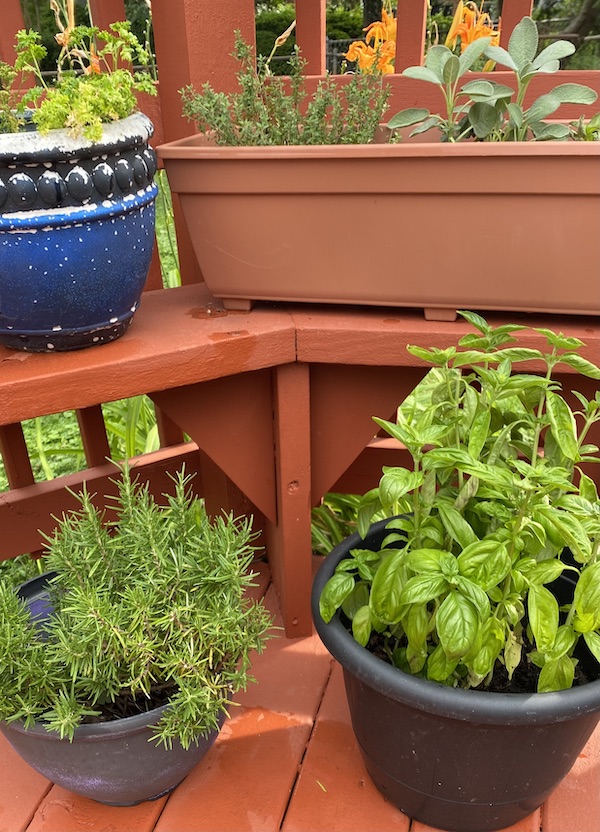 Herbs in containers on a patio deck. Photo by Mindy Nash.What should you grow in your containers? Anything goes, from bananas to peanuts. Choose edibles that you enjoy eating, are hard to find, enhance your cooking experience or simply make you smile. Grow potatoes in a bushel basket, thyme in an old boot, or cucumbers in a window box. Plant a salad garden in a whiskey barrel or pizza fixings in an old plastic kiddie pool. Corn isn't recommended, but if you could find a big enough container for a four-by-four block of corn, why not? To grow up, put bamboo poles or a trellis in a pot and train beans, cucumbers, tomatoes, or even squash to go vertical.
One of the best reasons for using containers is the ability to place them at your level. Put them on upside down pots, tables or old picnic benches. No more bending over to tend plants or pull weeds. It is a perfect gardening solution for older adults or anyone with limited mobility. When choosing a pot size make sure the gardener can easily reach across the pot or have access from all sides. Gardeners who use a wheelchair should have space to slide under; consider building a table with the perfect dimensions.
No matter what the reason: lack of space, design dilemmas, soil restrictions, or limited mobility, growing edibles in containers is easy, enjoyable and fruitful.
Types of Containers
Nurseries and discount stores have many possibilities. Look around the house and see if something can be recycled. Whatever you choose, make sure the pot has adequate drainage-unless of course you are growing edible aquatics!
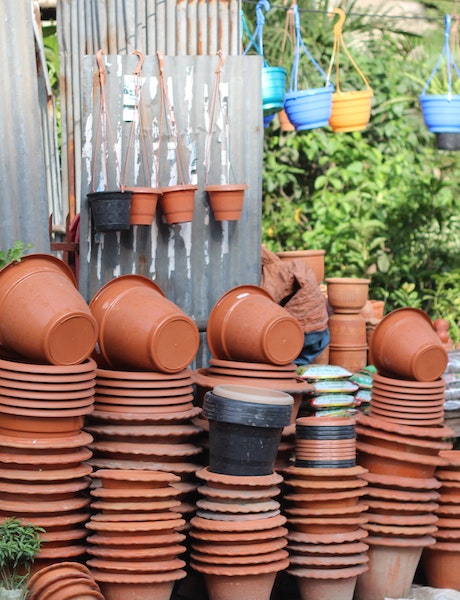 Multiple stacks of unused clay pots. Photo by Mahmudul Hasan Rifat, pexels.com.
Plastic is lightweight, relatively inexpensive, available in a wide range of sizes and colors, retains soil moisture longer than terra cotta, and easy to stack and store in the winter.
Terracotta is heavy, breakable, and can be expensive. It must be emptied of soil and stored out of winter weather to guarantee complete survival. The porous material "breathes," making terracotta the ideal material for growing edibles that prefer extremely well-drained conditions. Herbs like thyme, sage and rosemary grow well in terracotta pots. Concrete is heavy, durable, and usually expensive. It is a good choice for permanently placed container gardens and for overwintering hardy edible shrubs. Polyurethane foam can resemble the look of natural materials such as wood and stone and has the advantage of being lighter and less expensive than the materials it is imitating. Available in different colors and designs, containers are frost-proof, making it another good choice for overwintering hardy edible shrubs. Recycled plastic nursery pots are functional, but are not very attractive. Embellish them with fusion paints and stucco finishes. Use them as a base for mosaic masterpieces.
Container Gardening: Thinking Inside the Pot is reprinted with permission from Gardenline, Summer 2010.
