

The Show Must Go On…Virtually
by Debbie Waugh,
Green Spring Historian
“All the world’s a stage,” as Shakespeare wrote. Or it used to be. Nowadays the stage is a virtual platform. The “new normal” way of life under the pandemic has catapulted many of us—including Green Spring’s education staff—into a strange new virtual world, with no actual stage.
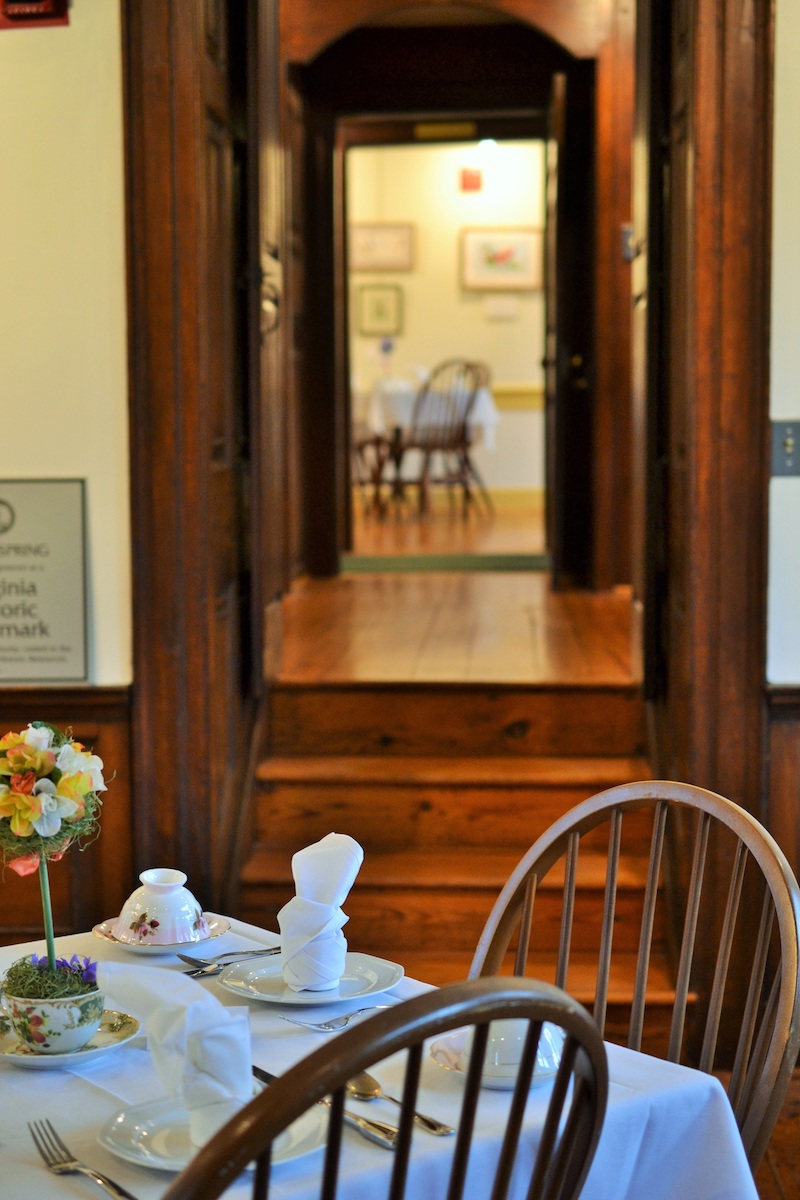 Table set for tea service at the historic house. Photo credit: Laura Strecker“Online” is the new “onsite” for many of our program attendees, including Historic House tea program guests. Afternoon tea boxes “to go” have replaced table service with elegant 3-tiered trays, china, linens, and silverware. Online lectures have replaced in-person presentations. Yet, while afternoon tea is an inherently social event, we are finding ways to keep audiences engaged, thanks to the ingenuity of our tea caterer and the wonders of Zoom technology.
For me, it’s both a gratifying and a daunting experience. One definition of the word “virtual” jumps out at me: “not physically existing.” That’s the daunting part.
When you are accustomed to speaking to a live audience—which is intimidating enough—moving to virtual delivery can be unnerving. Stage fright without the stage! Audience interaction vanishes when the audience is an inert computer screen, and building up a rapport is difficult when participants are mostly muted and invisible to each other. Can they really see and hear me now?
Programs should always be engaging, but a successful virtual program might have to be truly captivating! A virtual audience is apt to stray. Unlike a lecture room, home offers many distractions and diversions—children, dogs, and phone calls—that compete for attention. Is everyone still with me or have they wandered off?
Introducing humor can focus attention and help to create a shared experience, but without the ability to gauge a response it has the potential to be awkward. Should I give everyone a moment to laugh? Should I just move on quickly? IS ANYONE EVEN LAUGHING?
And then there’s the technology, the indispensable yet most formidable aspect of all (for me at least) which can make or break the whole undertaking. While it behooves all virtual speakers to become as conversant as possible with all aspects of the technology, I dread having to troubleshoot a glitch in real-time.
Of course, it is challenging for audiences too, and we are deeply grateful to attendees for their support of our virtual programs. A benefit of the online stage is the ability to reach far-flung audiences. In addition to many of our regular guests and others in the D.C. area, we have welcomed participants from New York, California, and Hawaii. Green Spring education programmers are currently testing virtual and in-person hybrid formats which may be the way of the future: bringing people near and far together to be informed, instructed, and entertained at Green Spring.
The show will go on! While we look forward to raising our teacups together again at the Historic House, we will continue to raise them at a distance. Stage or no stage, our virtual doors remain open, and I look forward to “seeing” you soon for afternoon tea!
