
The Continuing Legacy of Black Walnuts at Green Spring
by Gil Medeiros
The black walnut (Juglans nigra) is a fabled North American native tree, prized for its healthful nuts, beautifully figured wood, and comforting shade.
The magnificent black walnuts that have graced the grounds of the Historic House for more than 150 years have dwindled from three to one. Time, after all, overtakes all living things, even the most long-lived. The remaining specimen is truly a heritage tree. This one, a monument to good genes and good luck, stands behind the Historic House. It bears silent witness to much of the history of the farm that preceded the park.
 Green Spring’s last remaining black walnut tree adjacent to the Historic House.
There is some good news for Green Spring patrons who admire black walnuts and native trees in general. Black walnuts continue to thrive in the park’s natural areas. “They are most obvious in the Mixed Border (behind the back lawn of the Historic House) and the Virginia Native Plant Garden,” according to Brenda Skarphol, Green Spring horticulturist.
As recently as 2008, the landscape immediately surrounding the Historic House featured three mature walnut trees: one on the front lawn, two behind the house. Although we don’t know for sure, it appears these trees were planted at the same time. Who planted them? Unfortunately, the extant records of the farm do not say.
During the era these trees were planted, walnuts were seldom cultivated for their fruit. Because black walnuts were so abundant in the wild, people could walk in the woods and gather as many nuts as they wanted. More likely, they were planted as shade trees or as natural lightning rods to protect the farmhouse from summer storms. The latter was a common practice at farms of the times.
Photos we often rely upon to answer historical questions about the grounds were taken during the Beattie era of residence (1878-1914). Unfortunately, they do not satisfy our curiosity about the age of the trees. The photos are from the wrong vantage points to confirm the presence of the walnuts. Nevertheless, we estimate the trees were likely there, given the life span (150-250 years) and the fact that they all appear to have attained at least the average life expectancy.
The walnuts were already mature when the Straight family bought the farm in 1942. An interesting historical sidelight: the trees escaped the storied Beatrix Farrand redesign of the garden around the house in 1942 … but it was a close call. Farrand wanted to take down the two walnuts behind the Historic House. However, Michael Straight disagreed and insisted they stay. He considered them “witness” trees back then, further evidence that they had already been here a long time.
The end came for the walnut in the front yard in 2008. In deteriorating health, and storm-damaged, it was deemed to be a safety threat and taken down. Green Spring offered up the wood to local wood turners who eagerly snapped it up.
One of the two walnuts (behind the house) was Green Spring’s “wedding tree.” Michael Straight Jr. and his wife Audrey were married under the tree in the 1980s. This walnut was, in fact, a popular spot for weddings back in the day when weddings were permitted at Green Spring. But this walnut met its demise in early 2013. Failing health and the increasing threat to the safety of visitors and staff made the risk of keeping it too high. The stump was removed in late 2016 to make way for a replacement tree, a sturdy black gum.
The remaining walnut underwent some corrective surgery performed by County arborists last year. Somewhat rejuvenated by the removal of some dead wood, it has, we hope, a few more good years.
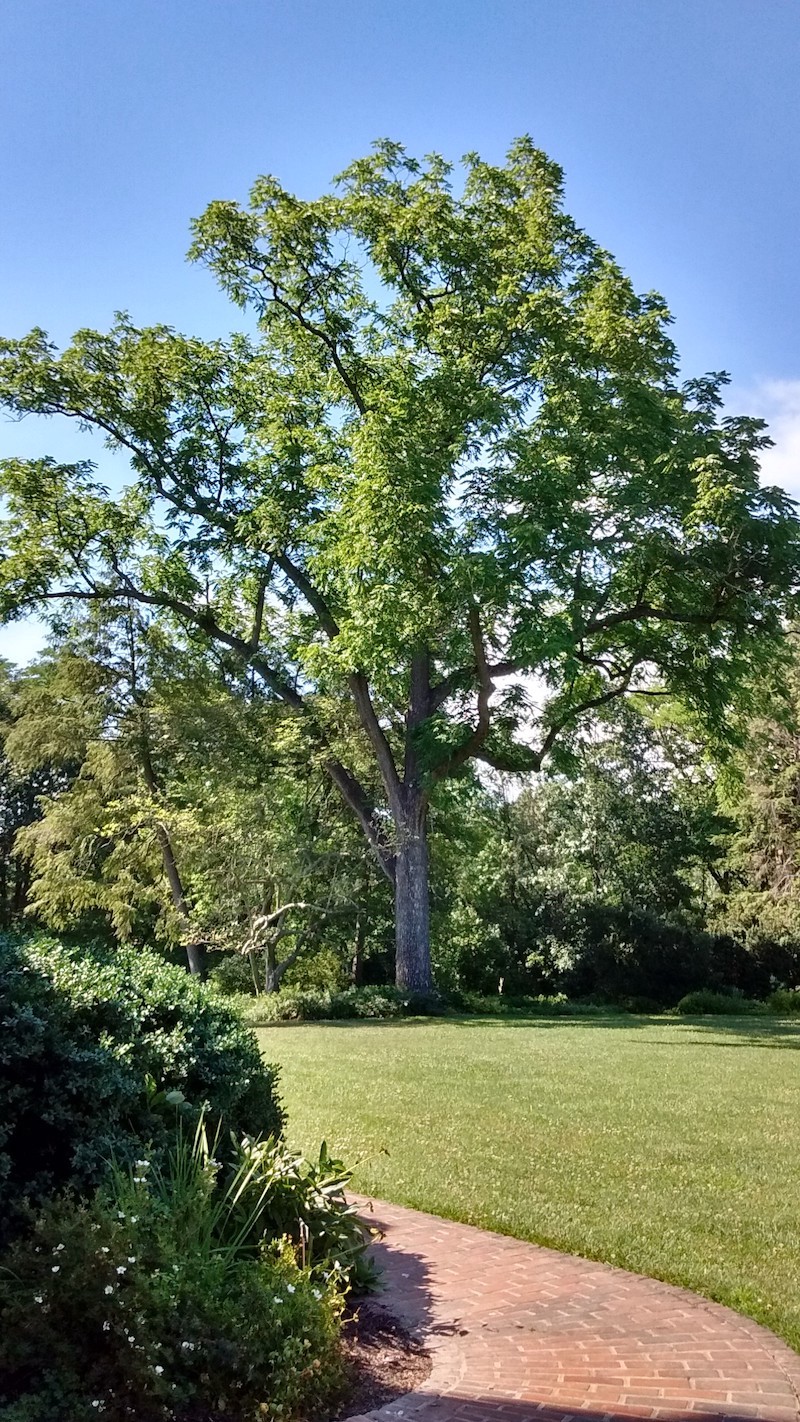 Another view of Green Spring’s last remaining black walnut.
Maybe you have admired the Green Spring walnuts for years and would like to add one or more to your landscape. To be fair, the black walnut is not wildly popular among gardeners. Here are a few points for you to consider.
A mature black walnut is a large tree. It has as much lateral spread as it has height, 90 feet or more. The native black walnut grows larger than the English walnut (Juglans regia). In either case this is a tree that fits best in a half-acre or more. If you choose an English walnut, make sure it is hardy for our area. Green Spring attempted to grow one years ago, but it didn’t survive the cold months.
If you want to harvest the nuts, you will need to grow at least two trees—dissimilar varieties or cultivars. Walnuts are like apples in this regard. For full nut production you will need cross-pollination.
Both black walnuts and English walnuts produce good nuts. The nuts you buy in the store are probably English walnuts. Quality and yield for English walnuts is considered slightly better on a tree that takes up less space.
There are modern black walnut cultivars that are more compact and have more consistent and tasty nut production. These may be more suitable for the suburban landscape.
Walnuts are great shade trees, but keep in mind that they are among the last to leaf out in spring and the first to drop their leaves in fall. If you are planting one, know that they grow fast in the early years. Make sure you plant it (or them) where the large fruit will not fall on your car or house.
Thousand cankers disease will likely be a threat to your tree. It has not reached Virginia yet, but its spread to our area seems inevitable. If you have any experience treating large trees for disease or insect infestations, you know it can be an expensive proposition requiring the services of a qualified arborist.
Finally, walnut trees are not friendly to many neighboring plants. The trees produce a chemical called juglone that is toxic to other plants. Juglone is in the roots, the limbs and the leaves of the walnut. It is not very soluble in water so it does not move far from the roots in the soil. Cleaning up fallen leaves, fruit, and other debris is important to controlling juglone.
If you want to have a garden adjacent to your walnut, you will not be able to plant tomatoes, peppers, or eggplants. Juglone is toxic to these plants. Ornamental plants in the same family as tomatoes such as foxglove will suffer the same fate. Most native plants, however, coexist happily with walnuts in the forest and are generally unaffected in gardens.
(All photos credit: Debbie Waugh)