
The Historic House: Frequently Asked Questions, Part I
by Debbie Waugh, Green Spring Historian
Visitors to the Historic House ask many questions about the house and the people who lived here. Here’s a selection of FAQs that we have received over the years. Perhaps you’ll find the answers to one or two of yours!
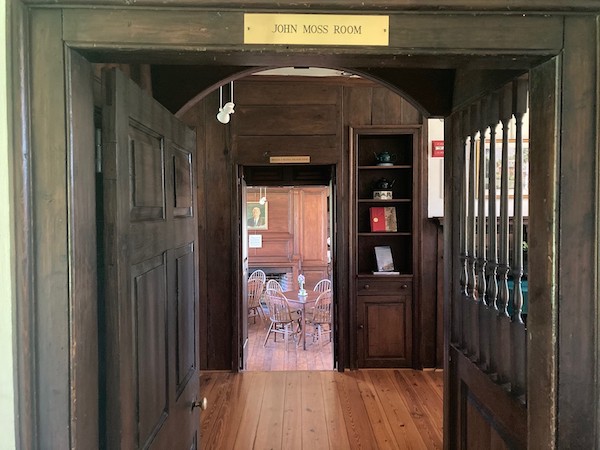 Interior of Historic House showing brass plaque that reads John Moss Room. Photo credit: Debbie Waugh.
When was the house built?
In 1784 by gentleman freeholder John Moss, a farmer and longtime justice of the Fairfax County court.
Was tobacco ever cultivated here? What was the original acreage?
Tobacco was grown on this land before John Moss established Green Spring Farm in 1777. However, he switched to cultivating cereal grains – oats, rye, barley, wheat, and corn – on his 540 acres.
Were there slaves at Green Spring? Where were the slave quarters?
We know that in 1795 John Moss had 14 slaves, some of whom he bequeathed to family members in his will. At this point we don’t know where they were housed or anything about their living conditions here. Research is ongoing to find out more about the “invisible” enslaved people of the Moss era and beyond whose stories are an integral part of Green Spring’s story.
Are the doorways low because people were shorter back then?
No, people weren’t that much shorter then. Doorways were made low to keep in the heat generated by the fireplace in each of the (original) four downstairs rooms.
Where was the original kitchen?
Probably where the Arbor Garden is now, based on archaeological finds in that area. Detached kitchens kept noise, smells, and fires away from the home. Around 1827 a kitchen was attached to the house, where the Michael and Belinda Straight Room is now.
Is the woodwork in the house original?
Not to the Historic House, but it came from eighteenth-century buildings in the area. In the 1930s, restoration architect Walter Macomber salvaged it from taverns and barns that were facing demolition and installed it here in 1942 as part of his Colonial Revival-style rehabilitation of the house.
Is this a restaurant? Can I eat my lunch in here?
No…and no, sorry! The tables and chairs are for our educational afternoon tea programs.
Is the house haunted?
Not that current staff are aware of (thankfully). But there have been ghost stories. Find out more at our “Are We Haunted?” tea program on October 31st!
More Historic House FAQs to follow in the next issue of Gardenline.