
Adapting to Our Environment
by Elizabeth Waugh,
GSG Children’s Education
Children’s Education offers a range of programs, but our school field trips have always been the most popular with teachers, focusing on specific subjects by grade following the Virginia Standards of Learning. One of our most popular, Predator & Prey, explores the ecosystem of Virginia: its flora and fauna, and how its living creatures interact with their surroundings and adapt to their ever-evolving environment. Little did we know when we taught our last school field trip in March 2020 that we would be the ones adapting to an extreme shift in our world and way of life.
As it became clear that schools would not be resuming in the spring of 2020, let alone our field trips, we started to brainstorm ways we could safely and effectively interact with the community. Fairfax County Park Authority partnered with Fairfax County Public Schools to help fill educational gaps and provide supplementary educational opportunities, and we spent the summer reconstructing our programs. We quickly surmised that our best asset were our park and the wonderful spaces in our gardens and along our paths.
Re-imagining two-hour field trips that have changed only slightly in the past twenty years was challenging. Most of our activities weren’t viable due to the constraints of social distancing. Even our “touch-tables” were out of the question— how could students safely examine our props and examples without them needing to be painstakingly disinfected between each use? This led to a massive overhaul of the programs, and we introduced our “Field Trips for All,” offering an adapted school field trip experience for distance and virtual learners.
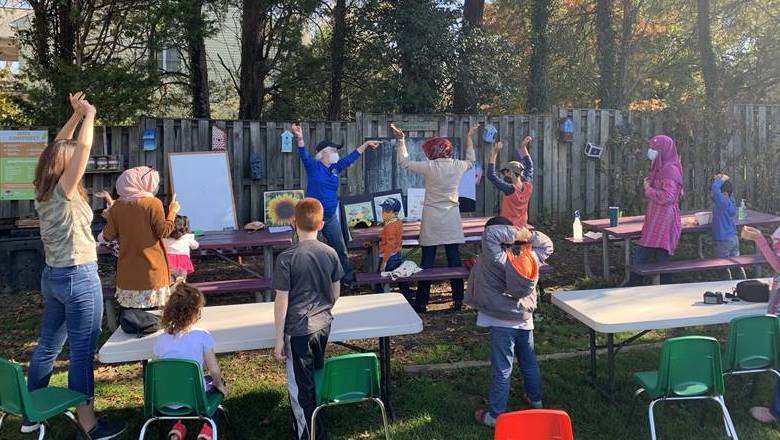 Children's education program at Green Spring. Photo credit: Elizabeth Waugh.
We were forced to reevaluate entrenched routines. We edited down the lessons to fit into a safer one-hour time frame and reinvented our activities to ensure social distancing. We brought all programs outside, and although wind and rain made quick adversaries, we were surrounded by nature and all of her surprising moments. A squirrel cracking open a nut, a hawk flying overhead, a garter snake coiling by the ponds—all were spectacular examples of the very creatures we were teaching about, wonderful moments that would otherwise have been missed had we been inside our classroom bent over a “touch-table.”
Our maximum number of students for each program shrank dramatically to no more than 12. We worried that our games and interactive lessons wouldn't translate well with smaller numbers and that lessons might feel awkward. But we had meaningful and engaged interactions with our students. We could learn their names, offer one-on-one conversations, and answer every single question.
We expanded our family programs, offering them weekly, and even added new programs to our roster that proved very successful. “Storytelling in the Garden” offers an immersive storytelling experience related to nature, and our private “Choose Your Nature Walk” gives families the opportunity to have a specialized garden experience. Many of the families are new to Green Spring and have become enchanted with their find.
For Children’s Education there have been some silver linings to the cloud that was 2020. Our programming skills were given an intense workout and dozens of local students benefitted from the experience.
None of this would have been possible without the help of our volunteers and Master Naturalist Rovers. Staff reductions meant relying on volunteers more than ever. Teaching was no small feat as programs were altered on an almost weekly basis, keeping us all on our toes and fostering a creative environment as we improvised on the spot.
The goal of the Children’s Education team has always been to engage with our youngest visitors and make a thoughtful and lasting impression. Studies have consistently shown that exposure to nature at an early age instills a love of the natural world and a desire to support parks. We’re proud that we’ve been able to offer an educational outlet for students during this strange time and give them a bit of fun to break up the monotony of quarantine and virtual learning.
Unlike Virginia’s wildlife, we didn’t have thousands of years to adapt to our changing environment, but we think we did fairly well over the last few months. Now on to more educational and adaptive moments in 2021!