
An Anniversary Retrospective
Compiled by Debbie Waugh,
Green Spring Historian
In 2020 Green Spring Gardens celebrates its 50th anniversary. The family estate of Michael and Belinda Straight was gifted to Fairfax County and, over the last half-century, has become a thriving horticultural, historical, and natural resource for the citizens of Fairfax County and its visitors.
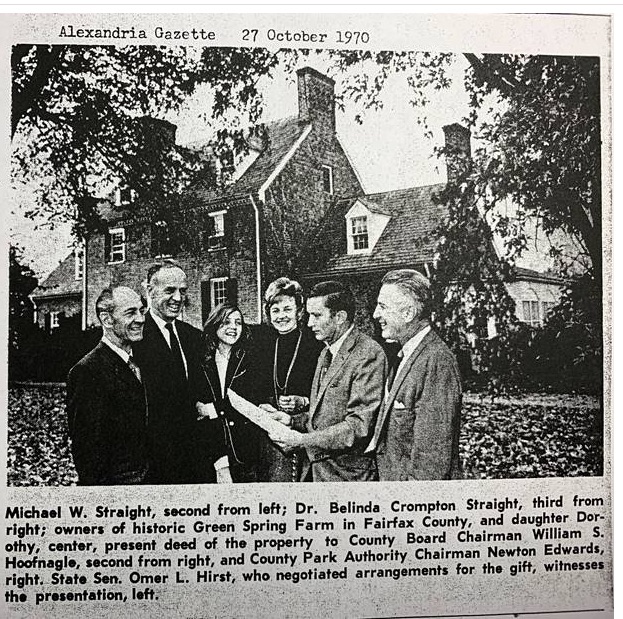 Photo from Alexandria Gazette dated October 27, 1970, showing Michael and Belinda Straight, and daughter Dorothy, presenting the property deed to Fairfax County and State officials.The official handover of the property took place on October 26th, 1970. To mark the occasion, the main content of this fall anniversary issue is a selection of excerpts from previously published Gardenline newsletters that document the development of Green Spring Gardens. The excerpts encapsulate some – but by no means all – of the important moments in our mission to connect the community to natural and cultural resources through horticulture, education, and stewardship.
We hope that you enjoy this retrospective, reflecting on the long path Green Spring has traveled to reach this exciting milestone and looking ahead to changes that the next fifty years will bring.
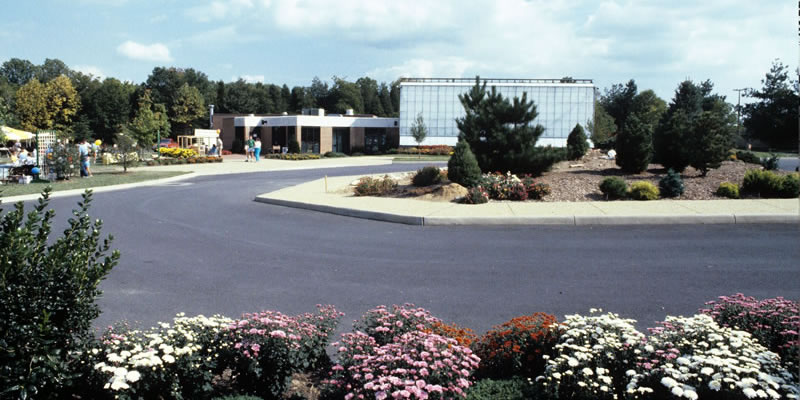
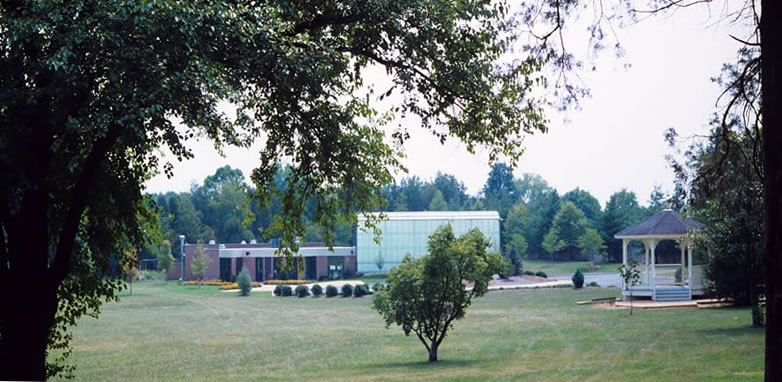 The Horticulture Center, early 1980's
“Getting to Grow on You”: The Eighties
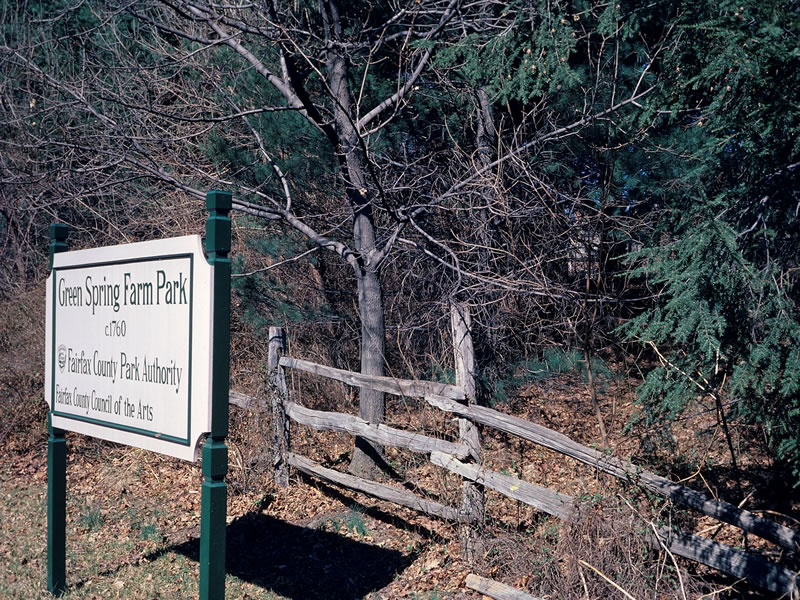 Original signage – "Green Spring Farm Park"Green Spring Farm Park opened to the public in 1975 as a public park, a historic site, and headquarters of the Fairfax County Council of the Arts. But a consensus quickly emerged to develop much of the park as the only public garden of the Fairfax County Park Authority (FCPA).
A small Horticulture Center and the adjoining greenhouse was built in 1982, and plans were made to develop the first of Green Spring’s 22 demonstration gardens.
When the park’s first newsletter was published in November 1984, work was in full swing:
“November should be a busy time… some things to watch for will be: final cleanup of pond area excavation; renovation and remodeling of plant displays inside the Horticulture Center and greenhouse; relocation and preparations for new vegetable garden next spring… We would like to thank everyone for their support, attention, and the opportunity to grow on you.”
And grow we did! However, success and setback go hand in hand in gardening. The March 1985 newsletter reported:
“Disaster Strikes. On January 20, the heat failed in our greenhouse resulting in the loss of 90% of our collection (valued at nearly $9,000). We are now working to rebuild our collection… we hope to develop a collection more spectacular than the one we lost.”
 Green Spring’s “Mayfest” – 1980's
Hope springs eternal in the garden and Green Spring moved forward undaunted! As the gardens grew, so did our public programs and events. In May 1986, visitors were invited to Green Spring’s “Mayfest,” the precursor of today’s annual Spring Garden Day:
“Treat your mom to a festive Mother’s Day garden party…Spend the afternoon browsing among displays and booths arranged by local plant clubs and societies. The Potowmack Chapter of the Virginia Wildflower Preservation Society (now the Virginia Native Plant Society) will be holding their annual spring sale… The Horticulture Center will treat every mom to a free plant and every child to a free helium balloon. Come join the festivities!”
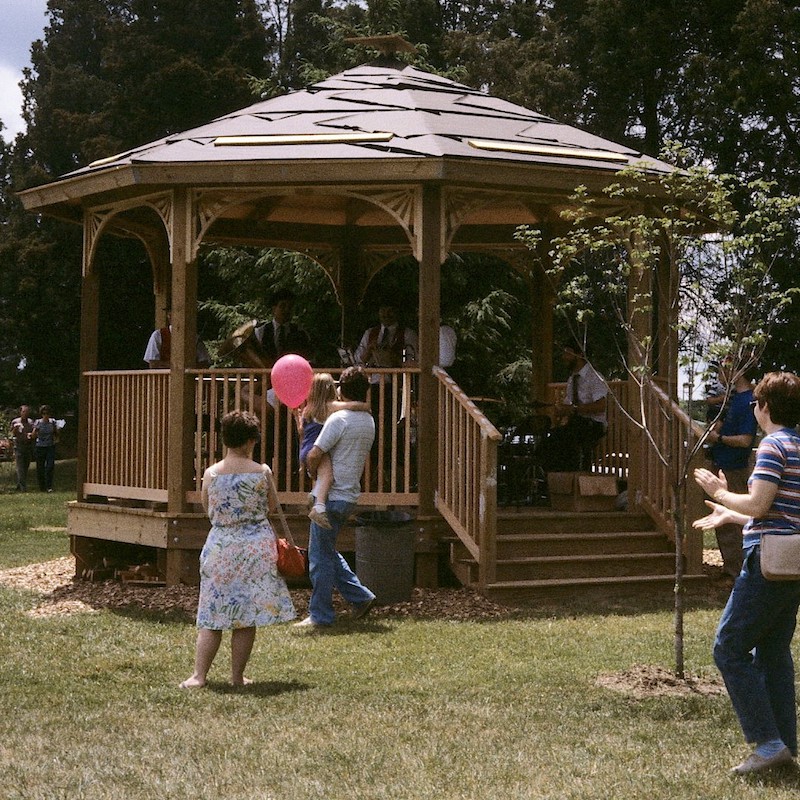 Concert in the Gazebo, 1980's
No helium balloons in the gardens today please! However, some things never change. Then, as now, we relied heavily on volunteers, as noted in the winter 1987 issue by then park manager Hollen Johnson:
“One of the best things about working in a public garden is the interaction with volunteers. This is especially true here at Green Spring Farm Park. Our volunteers encompass a fascinating range of backgrounds, and they bring an abundance of knowledge, enthusiasm, hard work, and good humor to share in support of the Park.”
This is as true now as it was then. Another constant has been Green Spring’s commitment to sharing the joys of gardening with children. The fall 1989 issue summed up the year-long Young Gardeners Program:
“Each gardener walked (or more often skipped or ran) away with well-deserved self-satisfaction and a taste for gardening that hopefully will grow in the years to come.”
In the years to come, Green Spring’s growth continued.
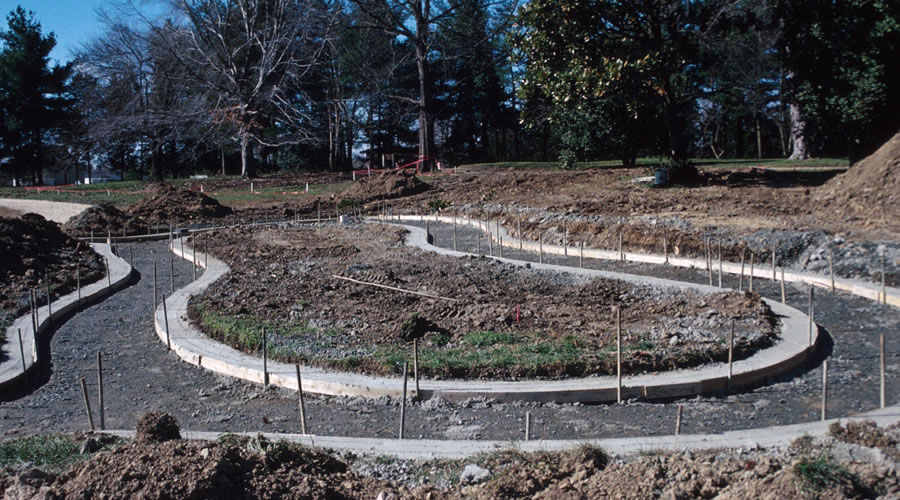 Rose Garden under construction.
Paving the Way: The Early Nineties
1990 was a big year for the gardens. The Mixed Border, Rose Garden (now the Arbor Garden), and seasonal displays around the Horticulture Center were planted. The April Gardenline of that year announced the construction of a familiar feature that connects different elements of the park:
“Many of the gardens and plant collections will now be linked together by a curvilinear footpath in the center of the park. Construction of the path will be completed this spring.”
The same issue also reported on another milestone development for Green Spring:
“Six witch hazels were planted near the park entrance in the fall of 1989. These witch hazels were purchased with a donation from the Chapel Square Garden Club. More will be added to the collection in 1990.”
Now our national collection is over 200 witch hazels strong!
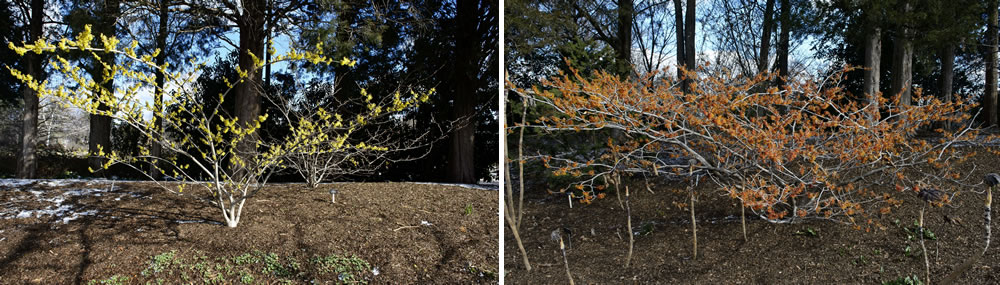 Green Spring Witch Hazels
The early nineties saw the Historic House open its doors to the public and the creation of the Art in the Garden program. These achievements were solely due to the work of a small group of dedicated volunteers, as reflected in the spring 1991 issue:
“VOLUNTEERS WANTED: Do you like gardens and history? Do you like meeting people? The Friends of Horticulture (precursor to FROGS) are looking for docents who can give four hours a month at the historic Green Spring Manor House… No previous experience is necessary! We will train you. Please call Dorothy Norpel, Art in the Garden Coordinator… April will mark the start of a new monthly exhibit series, Art in the Garden, displayed on the first floor of the Green Spring Manor House… featuring local artists whose works are of a botanical or horticultural theme.”
In the winter of 1992, Gardenline announced a new leader for Green Spring:
“This winter Don Humphrey became the new manager at Green Spring Gardens Park. His is a familiar face; for the past 5 ½ years he’s worked as a volunteer, seasonal, and permanent gardener. Beginning in 1986, he developed the fruit garden and later the rock garden and sycamore bed (today’s Shrub Border).”
Two major developments were reported in the last issue of 1992:
“In 1987 the Potowmack Chapter of the Virginia Native Plant Society concluded an agreement with Green Spring to jointly undertake the planning and development of the Virginia Native Plant Trail (Now the Virginia Native Plant Garden)… work on the completion of this fine garden is progressing very well.”
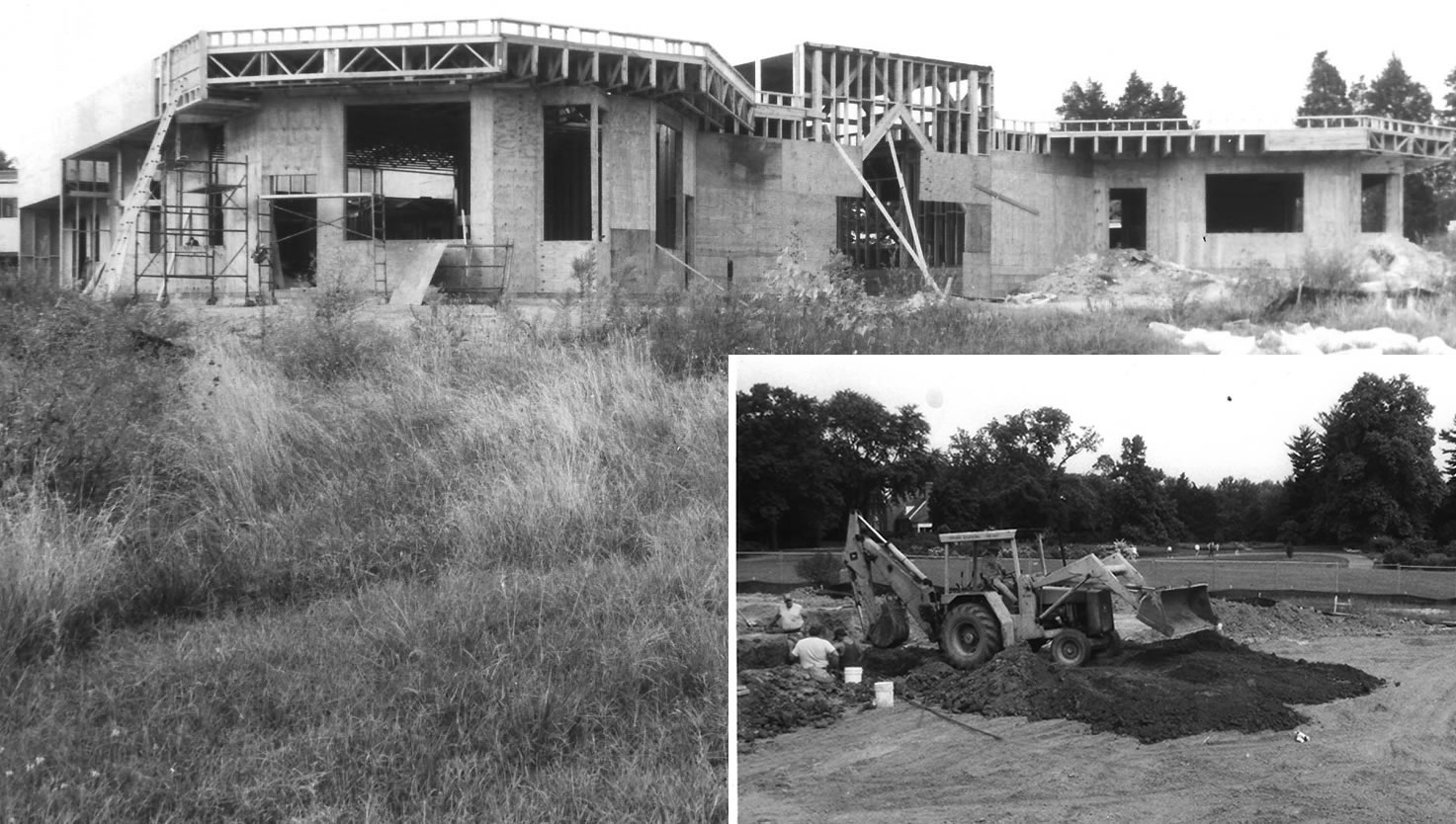 Horticulture Center under construction. Inset shows construction machinery and workers, taken May 26, 1993.
And in other big news:
“A general management plan for the park… calls for the expansion of the Horticulture Center and additional parking along with a number of new gardens. The Horticulture Center expansion, authorized by a bond referendum in the 1980s, is in the final design stages. This has to be the most important event in Green Spring’s 22-year history since it will provide a first-class facility for meetings, shows, exhibits, and classes.”
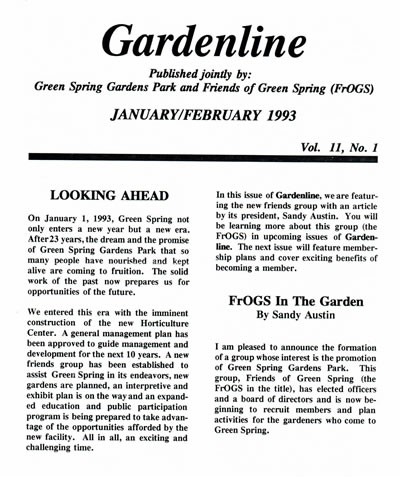 Cover of January/February 1993 GardenlineThe new year of 1993 was ushered in with a Gardenline that was, for the first time “Published jointly by Green Spring Gardens Park and Friend of Green Spring (FROGS).” It was to be an exceptionally exciting and challenging year for the park….
“The dream and the promise of Green Spring Gardens Park that so many people have nourished and kept alive are coming to fruition. The solid work of the past now prepares us for opportunities of the future.”
Green Spring would now seize those opportunities with the support of its newly formalized partnership with FROGS, announced by the group’s first president, Sandy Austin:
“I am pleased to announce the formation of a group whose interest is the promotion of Green Spring Gardens Park… the FROGS will be working closely with staff to improve the quality of the gardens and its activities.”
One of those activities – still sponsored by FROGS today - is Spring Garden Day. That year the event included a ground-breaking ceremony for the 7,000 square foot Horticulture Center expansion. Meanwhile, the gardens were expanding too, and plans were made to show them off:
“This year Green Spring is initiating a regular series of garden tours. These walking tours serve to introduce new visitors to the park and to trace the process of bloom and garden growth throughout the years.”
However, an upbeat year ended with bad news on the Historic House front:
“A structural analysis found the second floor of the Manor House unsafe for occupancy… A work plan is being prepared to determine the needs and cost of putting the house in good repair. Built around 1760 (later determined to be 1784), the Manor House’s central portion is one of the oldest structures remaining in the county, and its preservation was one of the major reasons for the park’s establishment.”
The first issue of 1994 brought breaking news about Gardenline itself:
“Look carefully at the issue you are holding. It looks good, doesn’t it? This issue premieres the new laser jet printer at Green Spring… a special thanks to the members of the FROGS board for their support.”
As state-of-the-art technology at Green Spring advanced, so too did provisions for visitor safety with a new parking lot plan announced in the fall of 1994:
“The plan calls for the closure of Green Spring Road through the park with access to the new parking lot via Green Spring Road from Route 236, Little River Turnpike. Closure of the road through the park will unite both sections of the park and remove a serious safety threat to pedestrians by cars on the steep, narrow section of the road between the Manor House and the Spring House. A considerable portion of the new parking lot will be located on the existing road bed.”
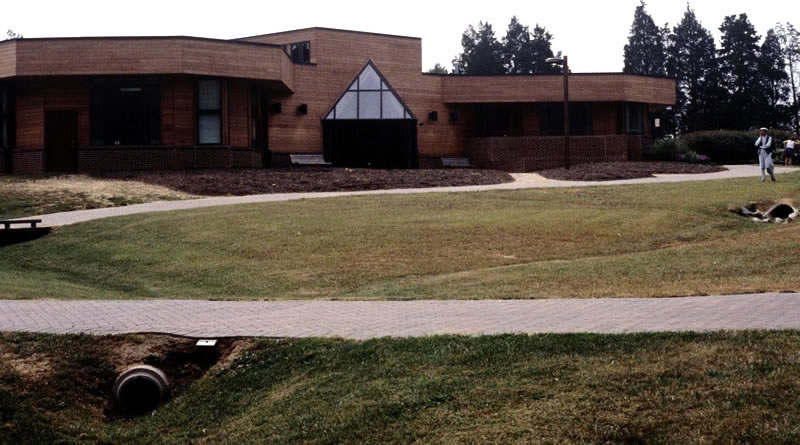 Green Spring's Swale Garden, 1994
By year’s end, many projects were falling into place:
“With the official closing of Green Spring Road and the approval of plans for the new parking lot, the way is clear for opening the Horticulture Center.”
“Rehabilitation work continues on the Manor House.”
“By the end of 1994, four new gardens will be completed. They are: the seasonal display garden in front of the Horticulture Center, the expansion of the Rock Garden, the Greenhouse… and the north Horticulture Center garden (now the Waterwise Garden) where the emphasis is plants with low water requirements.”
“Three other gardens are in the active stages of planning. These are the townhouse gardens, the swale garden and the shade garden (now the Concentric Garden).”
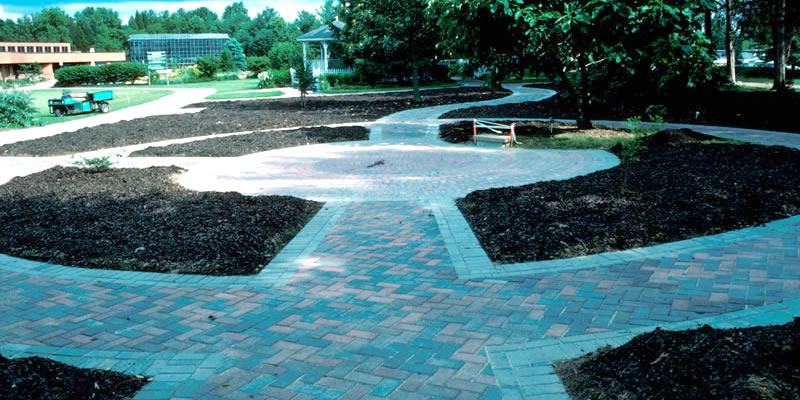 Green Spring's Concentric Garden, 1994
A Banner Year: 1995
The halfway point of Green Spring’s first half-century was a dramatic turning point for the park. 1995 was the landmark year that saw the park take on much of its present-day shape. In that new year’s issue, manager Don Humphrey declared fittingly:
“The Future is Now. On December 1, 1994, almost unnoticed, the doors to the new Horticulture Center opened to the public. No bands played, no fireworks were set off. The doors that had been locked during construction were quietly unlocked at 9 am and a number of visitors wandered in and looked around. Yet this was a momentous occasion for it marked the beginning of the final phase of Green Spring’s development – the completion of nearly all the gardens… and the initiation of the greatly enlarged public use and education programs at Green Spring.”
If you build it, they will come… and with more space came more programs and events:
“We will be scheduling a greatly expanded slate of programs on a wide variety of horticultural subjects. Programs will include speakers, panel discussions, audio-visual presentations, and tours of the gardens, all designed to stimulate participants to become more knowledgeable and involved in the quality of their home environment.”
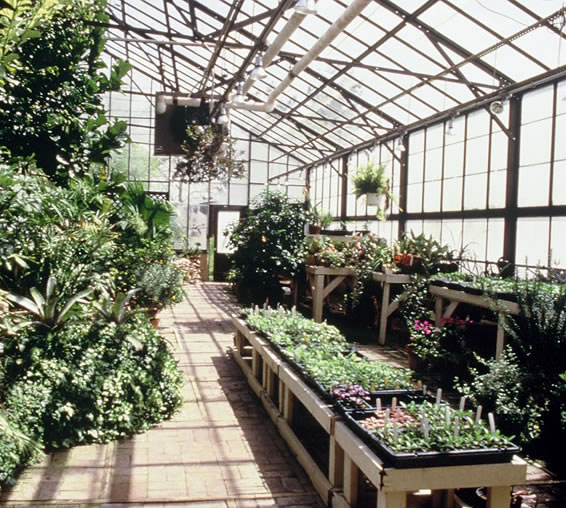 Green Spring's glasshouse, 1990'sThe greenhouse was redesigned as part of the Horticulture Center development, and its plant collection adapted accordingly:
“All the trees and large plants were given to the National Zoo for use in the various animal houses. In their place is completely new staging and nearly 1,000 houseplant species and cultivars, the south end devoted to cacti and succulents.”
Work on all fronts went full steam ahead that spring…
“With work nearing completion on the renovation and restoration of the Manor House, emphasis shifts to the construction of the new parking lot, the installation of permanent exhibits in the Horticulture Center, and the development and planting of new gardens. The June 17 dedication date for all of these facilities will provide a strong impetus to get on with the work… by early June this battle should be won.”
In the May/June issue, Don’s update reflected the frenzied pace of work to meet the deadline:
“The rush of bloom in May and June is beyond belief, but it doesn’t hold a candle to the rush of work by contractors and staff as all activity points toward completion by the June 17 dedication of the park… Please excuse the brevity of this article while we get back to work on the gardens and other things.”
And in Historic House news that spring:
“The Manor House at Green Spring is slowly coming back to life. The contractor has left, the dust has settled, and after a year of renovation the front door will again be open on June 17 when the new Horticulture Center will be dedicated. The staff is proud of the new interior with its new catering kitchen… plans are underway for programming ‘Tours and Teas’… ”
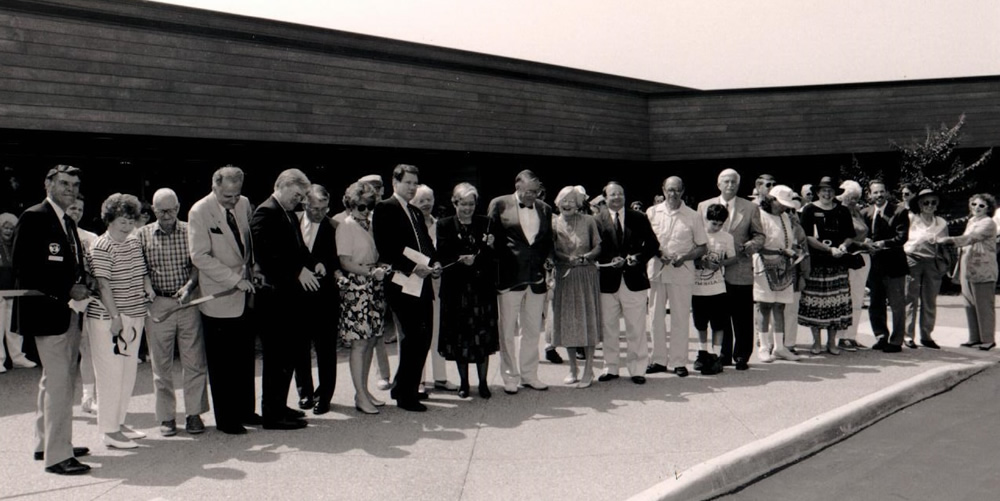 Dignitaries and attendees at the dedication ceremony of the new Horticulture Center, June 17, 1995
By mid-June, the battle was indeed won and in the summer issue Don Humphrey reports on a glorious dedication ceremony of a Green Spring for the future…
The dedication of Green Spring Gardens Park took place on June 17, with appropriate ceremony. Over 300 people attended the outdoor event. The weather was perfect, the new parking lot was quickly filled as was the overflow lot, the speeches were inspirational, and the ribbon cutting in front of the Horticulture Center was appropriately climactic….
Congressman Tom Davis, former chairman of the Fairfax County Board of Supervisors, spoke of the dedicated efforts of many people who had worked to make Green Spring a reality… Dr. H. Marc Cathey, president of the American Horticultural Society, gave the keynote speech… I read a resolution from the FCPA board praising the work of the Friends of Green Spring (FROGS) in assisting the park with its mission….
After the ceremony, visitors were able to walk around Green Spring and discuss the park and the different gardens with staff and volunteers. All in all, it was a wonderful and memorable day.”
From the other side of the lawn, the Historic House reported:
“Dignitaries came and made their speeches… and the Manor House officially opened to the public on June 17. But there has been no time to rest on our laurels. With a helping hand from the press, the public has found the park... ‘Count me in’ has been the response to the Manor House Tours and Teas schedule in September…”
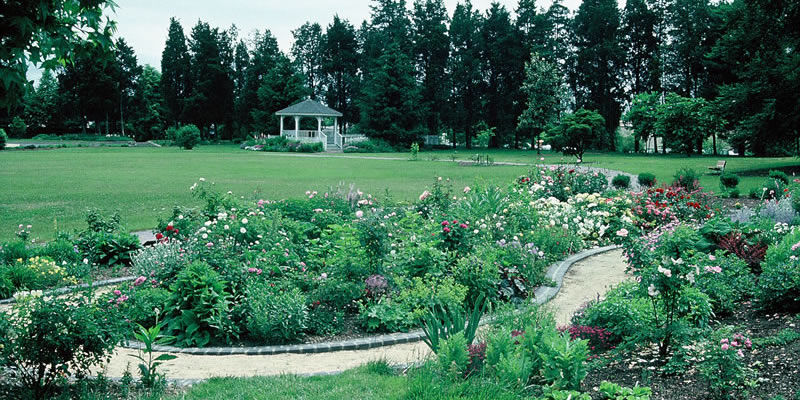 Green Spring's Rose Garden, 1990's
Nobody at Green Spring rested on their laurels that year! By the fall, attention quickly shifted to yet more new goals and objectives: improved visitor services; continued upgrading of gardens; expansion of educational programming; and bringing the Historic House into full operation. In the fall issue, Don also wrote about the beginning of the park’s horticultural outreach program:
“Fairfax County Park Authority’s comprehensive plan sees Green Spring as the focal point for county-wide horticultural outreach. Green Spring has for years administered some 800 garden plots in 12 county parks. We will continue to upgrade this program.”
He concludes: “So, if it seems we are even busier than usual, we are.”
“On Solid Ground”: The Late Nineties
1996 was a year of ups and downs. Calamity struck early in the year:
“This has been a winter to remember, and to forget. The 1996 record-breaking snow is not all that came down; the ceiling trusses in our multipurpose room gave way under the snow’s weight on February 2nd. Because of the timely discovery by Frank Jankauskas, we had it shored up to avoid the threat of total collapse… Work quickly got underway to repair the damage.
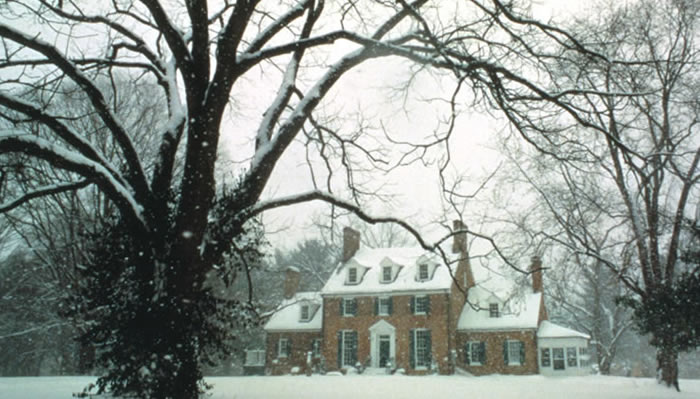 Historic House covered in snow, late 1990's
Unfortunately, the fiscal environment has also had a chilling effect. Fairfax County expects a significant budget shortfall…”
Déjà vu all over again! This wasn’t the first, nor would it be the last time that Green Spring has had to weather fiscal woes that have critically impacted staffing levels and resources. However, Don’s message was upbeat:
“We expect to weather these conditions and to flourish. We will continue to give top priority to serving the public and will not lower the quality of our services. In fact, we hope to be innovative enough to improve them. Regardless of the climate, we intend to enjoy and draw inspiration from the gardens and invite you all to join us in this wonderfully civilizing activity.”
Words to live by, then and now. The same issue quoted garden writer Allen Lacy, who had “discovered” Green Spring the previous fall:
“Green Spring is impressive in every way… The most wonderful thing about this park is its determination to serve local citizens. It would be most unimaginably beneficial to horticulture in America if there were hundreds, even thousands, of such local parks, designed to show the opportunities and possibilities for gardening in their immediate vicinity.”
Sadly, another meteorological misfortune struck in 1996, as noted in the fall issue:
“A hard-hitting storm with tornado-like winds roared through Green Spring on June 24, toppling part or all of 35 trees. Park staff and volunteers worked under direction of Frank Jankauskas to get the worst of the mess cleaned up. White pines were particularly hit hard and a large area in front of the Manor House is now without trees.”
In other more gratifying news, “From the Lily Pad”(the original “FROGS Talk” column) reported:
“We are honored and pleased that Friends of Green Spring received the Elly Doyle Park Service Award this year for ‘… an organization contributing most to the county park system.’… We now count more than 500 members of FROGS. We hope all of you will continue your helpful and much-appreciated support of Green Spring Gardens Park.”
The January/February 1997 issue announced Don Humphrey’s retirement:
“In a brief six years, Don oversaw the development and installation of ten new gardens, helped to form the Friends group (FROGS), and managed the planning and construction of the new Horticulture Center and parking lot. It is hard to imagine a more pervasive touch at Green Spring Gardens Park than that of Donald W. Humphrey.”
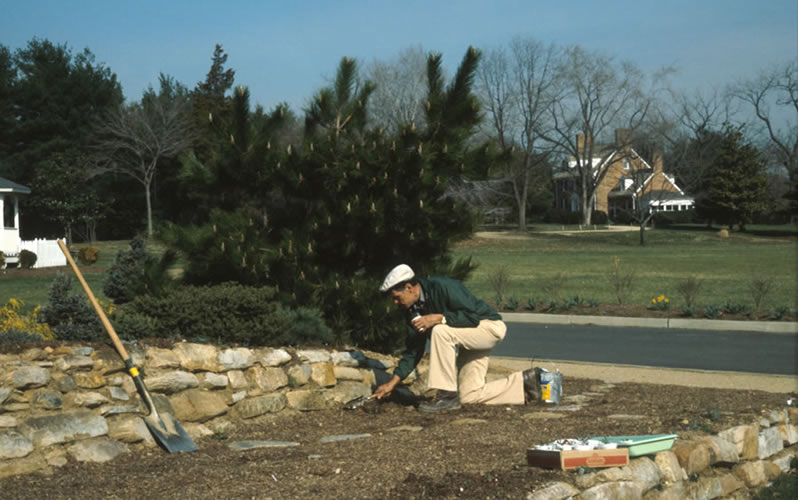 Don Humphrey in the Rock Garden, circa 1980
Thanks in large part to Don’s stewardship, Green Spring’s foundation was strong. His last Gardenline article as park manager was featured in the March/April 1997 issue.
“Today the park is on solid ground. Most of the planned gardens have been developed, a competent staff is in place, the education program continues to grow in variety and public acceptance, and garden enhancement in underway… The strands that run through all of the park’s diverse activities weave the vision of what Green Spring is all about – community and the quality of the home environment made possible through education, understanding, and commitment.”
In spring 1998, Green Spring welcomed its new manager, Chris Strand, who wrote:
“Green Spring is a tremendous horticultural and educational resource for the community and yet I think… it is underappreciated. I would like to see Green Spring get the attention and recognition it deserves. I would also like to see Green Spring get the funding it needs to realize its potential.”
The same issue welcomed new assistant manager, Sherrie Chapman:
“Sherrie is interested in expanding the number of programs offered at Green Spring and raising public awareness about the park. In addition, she is interested in the historical landscape of Green Spring…”
Speaking of history, by the fall of 1998:
“Visitation at the Manor House has increased substantially and there is a continuing demand for our teas…sincere apologies if we were all booked when you tried. The winter tea schedule has something for everyone, from poets to presidents…”
The last year of the decade saw Don Humphrey’s return to Green Spring to assume the presidency of FROGS….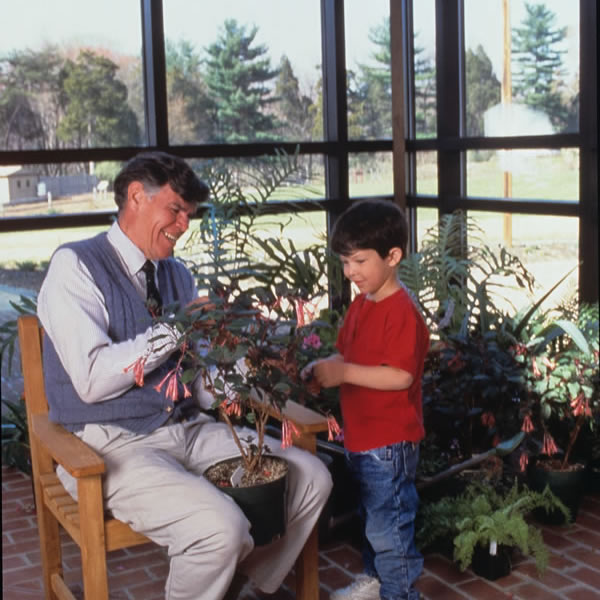 Don Humphrey with young visitor, late 1990's
“Since its first year, FROGS has provided financial assistance to Green Spring, receiving its monies from various sources, including memberships, plant sales from our Spring and Fall Garden Days, donations, and programs – particularly the very popular Winter Lecture Series. You will see the results of these dollars in 1999 in the development of five new, enlarged, or revamped gardens as the park continues to implement its General Management Plan.”
New Millennium Milestones: The 2000s
In the spring 2000 issue, Chris Strand summed up a successful closeout to the nineties:
“This last year was a busy and exciting one at Green Spring… This spring look for the new Backyard Wildlife Habitat Garden, a newly planted Manor House Vista, a newly planted Children’s Garden… and improvements to the stream and pond areas.”
Later that year, Chris reported landmark news in the winter Gardenline:
“Green Spring Unveils New Logo. On Friday, October 20th I unveiled our new logo and announced that Green Spring had been selected by the American Association of Botanical Gardens and Arboreta* to sponsor the national witch hazel collection. The new collection will be both a spectacle the public can enjoy and an important resource for botanists and horticulturists.
Our new logo… clearly relates to our new collection, it is also emblematic of Green Spring and our future as a public garden. It reflects our quest to find new and interesting plants and our desire to promote the best of these for use in our region.”
*The witch hazel collection is now recognized by the Plant Collections Network of the American Public Gardens Association.
Green Spring continued to expand its county-wide horticultural outreach. By 1997, in addition to managing garden plots, the park had also assumed responsibility for the county’s farmers markets. In the fall of 2001, a community horticulture trifecta was achieved:
“Master Gardener Plans Hatching… our new Master Gardener Program is in the fledgling stage. We hope to be out of the nest and flying by winter 2002!”
In the 2002 winter issue of Gardenline, as the nation dealt with the trauma of the September 11 attacks, Don Humphrey struck a hopeful chord, underscoring Green Spring’s role in lifting dampened spirits and making the world a better place:
“My view of gardening is that … it is valuable in enriching the environment and giving us a feeling of connectedness to nature. As certainly as defending against terrorism and its nihilistic view of life, these concepts are valuable in a broader context that will make us better informed and responsible citizens for the entire world’s environment. That is why I am so pleased with two of Green Spring’s educational endeavors: the school programs for children and the new Master Gardener program that debuts this year.”
Winter 2003 brought an important stamp of approval for Green Spring as a professional museum organization:
“Green Spring received notification from the American Association of Museums (now the Alliance of American Museums) that the AAM Accreditation Commission had voted to grant accreditation to Green Spring Gardens. Accreditation is a recognition of our commitment to excellence and high professional standards. Only a handful of public gardens in the United States have achieved this goal.”
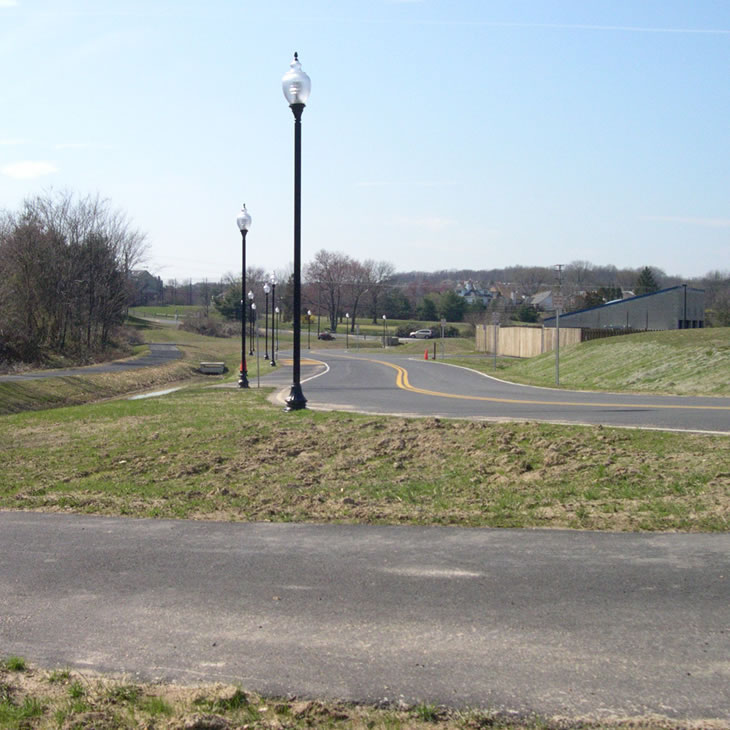 New entrance and parking expansion, early 2000's
And in other major news, Chris Strand reported a big change for the park in the fall 2003 issue:
“New Entrance to Green Spring. As part of the 1998 bond program, a proposal to create a new entrance to Green Spring was enthusiastically supported by the staff, volunteers, and the Friends of Green Spring. With the new entrance we will be getting another 55 parking spaces and new areas to plant trees and shrubs.”
In 2004, while Green Spring looked to the future, Historic Green Spring was also in the spotlight. Thanks to the work and acumen of assistant manager and historian Sherrie Chapman, the site was placed on the National Register of Historic Places and the Virginia Landmarks Register:
“Although most visitors know that the brick house at Green Spring is old and probably would not be surprised to learn that it had been listed … they would most likely be astonished to learn that the nominations were based… on one year, 1942. In that year, Michael and Belinda Straight commissioned two American masters, Walter Macomber and Beatrix Farrand to redesign their recently acquired Green Spring property. Together, Macomber and Farrand created a historic designed landscape that is a unique combination of 20th century architectural and landscape design.”
Mary Olien, who succeeded Chris Strand as manager in 2005, set goals to conserve Green Spring’s cultural resources and initiated a Cultural Landscape Report study for the entire site as reported in the spring 2007 issue:
“With the addition of Green Spring to both of these registers comes the responsibility to manage the resources. Future generations can reap the benefits of knowing the cultural and historic significance of this land. A well-conceived Cultural Landscape Report will become an invaluable tool for us to achieve this goal.”
In the summer of 2008, Mary also reported the completion of the Streambank Stabilization Project for the section of Turkeycock Run that flows through Green Spring:
“… erosion has been significant along the streambanks closest to the ponds and just above the pedestrian bridge in the Virginia Native Plant Garden. Once the trails are open again you will be able to see the strategies used to protect the streambanks…
The area looks quite different now as 48 trees of varying sizes have been removed… During the replanting phase, 94 trees representing 6 native species will return to the area. In addition, over 400 shrubs will be interspersed among the trees.”
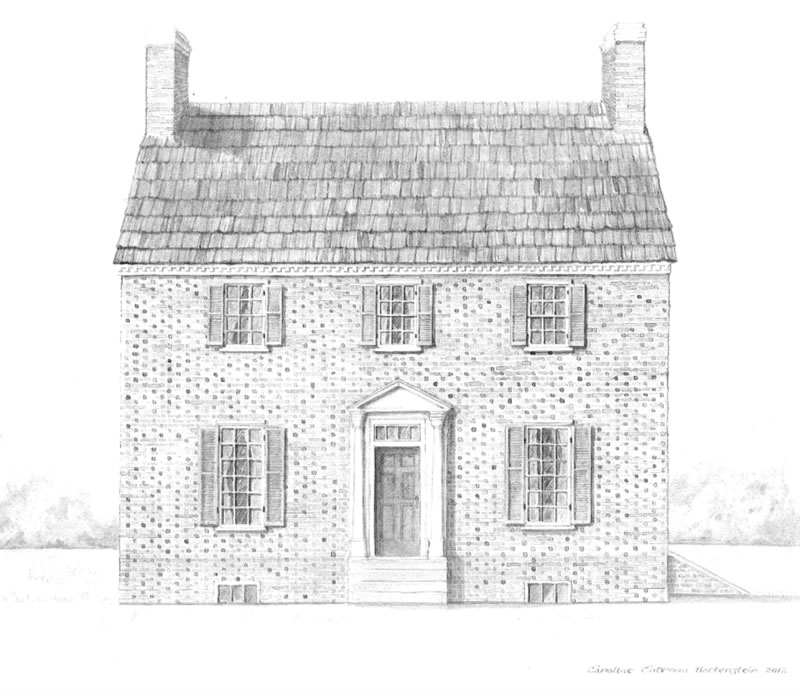 Historic House as it may have looked in 1784. Drawing by Caroline Hottenstein.
In exciting Historic Green Spring news that year, the 1784 construction date of the Historic House was finally determined through the science of dendrochronology:
“It’s a very precise way of dating historic buildings by tree-ring patterns in construction timbers… The final analysis report for Green Spring states that the statistical chance of the cross dates being incorrect is ‘much, much less than 1 in 1,000.’”
The Latest News: 2010-2020
Here are just a few of the highlights from this, the fifth decade of Green Spring Gardens.
The fall 2010 Gardenline documented another “historic” milestone:
“The Fairfax County Park Authority, in cooperation with the Friends of Green Spring and the Virginia Department of Historic Resources celebrated the installation of a new historic highway marker on June 12, at Green Spring Gardens… there were special comments from a very special surprise guest, Dr. Belinda Straight….”
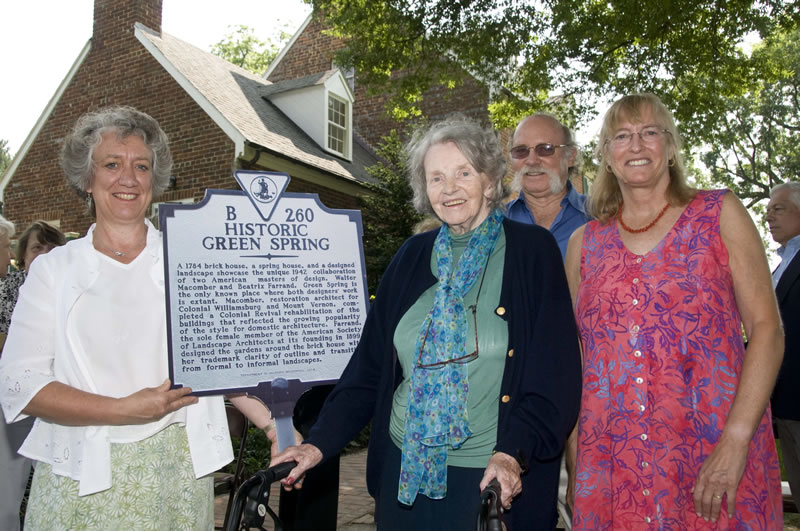 Historic highway marker installation, June 12, 2010. Left to right: Mary Olien, Dr. Belinda Straight, Michael Straight, Jr., Audrey Straight.
Meanwhile FROGS continued its unwavering advocacy and financial support for the park:
“2011 was a very busy year… we purchased a new riding mower and a new ceiling-mounted digital projector; funded much-needed tree work; paid for the planting of more trees in the ponds area; and wrote a check to FCPA to get the Garage/Classroom renovation project off the ground….”
2012 ended on a very positive note, as reported by Mary Olien:
“Every year the Fairfax County Park Authority recognizes outstanding performance with Trailblazer Awards… This year Green Spring Gardens received the Site of the Year Award… During the past fiscal year the staff generated more revenue, offered more programs, served more school children, planted more trees, removed more invasive plants than ever before….”
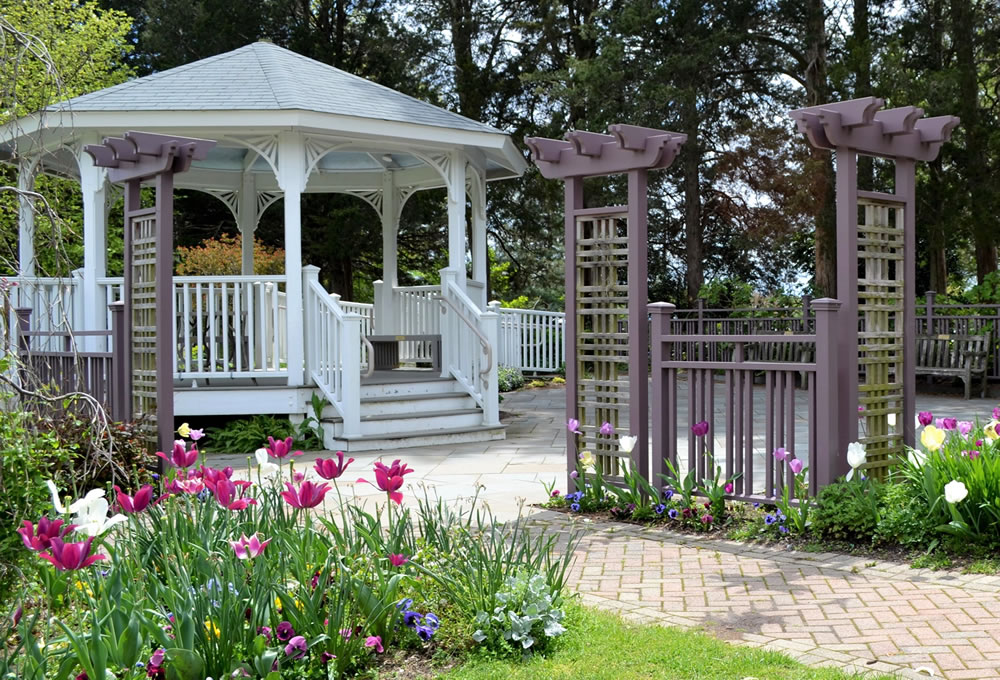 Gazebo and Patio Garden as it looks today.
In the winter 2014 issue, Mary announced pivotal work to create a new major planning document – a Master Plan Revision to update the original General Management Plan of 1992– that will guide Green Spring into the future. In the meantime, these projects were already underway or about to be:
“The renovation of the gazebo patio should be well underway by the time you read this. With funding from Virginia Tech, we are renovating the fruit garden area. The bridge across Turkeycock Run will be replaced about a year from now…”
In Historic House news, fall of 2014 saw the introduction of a new and successful program that did not include tea and scones:
“This fall the Historic House offers a taste of Scotland’s independent spirit (pun intended) with a Scotch whisky tasting program.”
Cheers! In summer of 2015, there was more exciting news from Historic Green Spring:
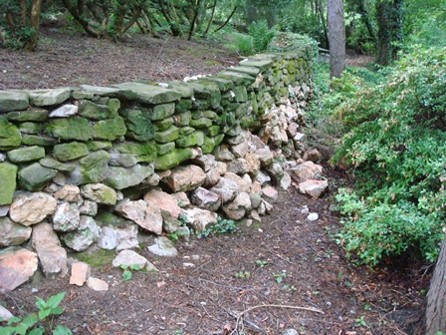
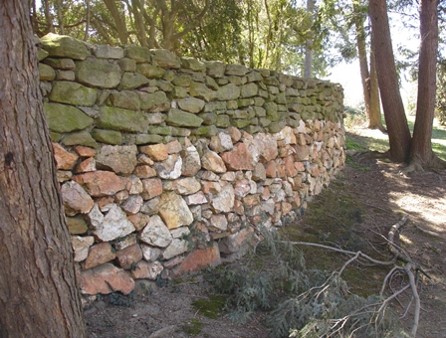
“On June 10th, the Garden Club of Virginia officially presented the restored Beatrix Farrand landscape to the Fairfax County Park Authority at a ceremony hosted by Green Spring… The restoration of key elements of Farrand’s garden here ensures that the hallmarks of her designs continue to be accessible to the public…”
 |
 |
|
| Before (left) and after (right) photos of the Beatrix Farrand landscape wall restoration. | ||
In 2016, FROGS took a giant leap forward with social media communications:
“A big step for FROGS was our social media launch with the exciting new website (www.friendsofgreenspring.org) as well as a presence on Facebook, Twitter, and Instagram.”
The FROGS 25th Anniversary Issue appeared in the summer of 2018:
 logo used for FROGS 25th year celebration“Thanks to you, FROGS membership numbers increased from 162 by the end of 1993 to nearly 1,500 today. And thanks to your generosity… over the past 25 years FROGS has contributed over $1.9 million to support Green Spring Gardens!”
A big change for Gardenline came with the winter 2019 issue, as reported in FROGS Talk:
“Happy 2019! Welcome to FROGS’ second quarter century… and to our first digital edition of Gardenline! We’re excited to present dynamic content and bring Green Spring stories to life with crisp, colorful imagery…”
In the same issue, Nicole Conners, who became park manager in 2017, announced an important professional collaboration for the park:
“I would like to thank FROGS for the sponsorship to be a partner garden with the American Public Gardens Association (APGA) 2019 Annual Conference. APGA will come to Washington D.C. this June and Green Spring will host a conference tour. Several staff have been selected to represent Green Spring during presentations…”
Nicole also reported this noteworthy development in the spring 2019 issue:
“It is very exciting to be watching the reestablishment of the historic driveway in front of the Historic House. Restoration of Beatrix Farrand’s 1942 curved driveway as a walkway was recommended in our Cultural Landscape Report (CLR) and in Green Spring’s 2016 Master Plan Revision. This is the first element of the Master Plan to be implemented in the gardens.”
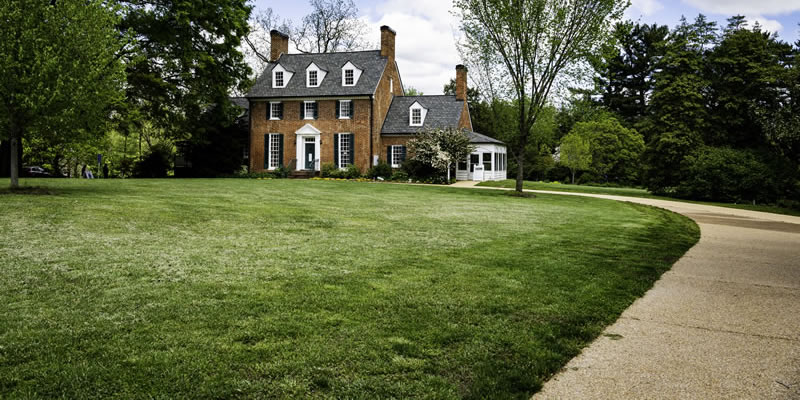 Reestablishment of the historic driveway, 2019.
Meanwhile, more change was coming to Historic Green Spring to enhance the visitor experience:
“The Historic House gift shop will be rearranged to offer visitors a new multi-media experience. We’ll still have assorted teas and tea-themed items for sale, but visitors will also be able to learn more about our history with a permanent photo exhibit and two short videos that bring Green Spring’s past to life.”
And in other important news last year:
“… this should be the last summer staff will have to manually water the grounds. Green Spring was awarded an Environmental Improvement Program (EIP) grant by Fairfax County for fiscal year 2020. We are honored to receive $138,000 in funding for smart irrigation, which will get us moving in the right direction for environmental sustainability and staff efficiency.”
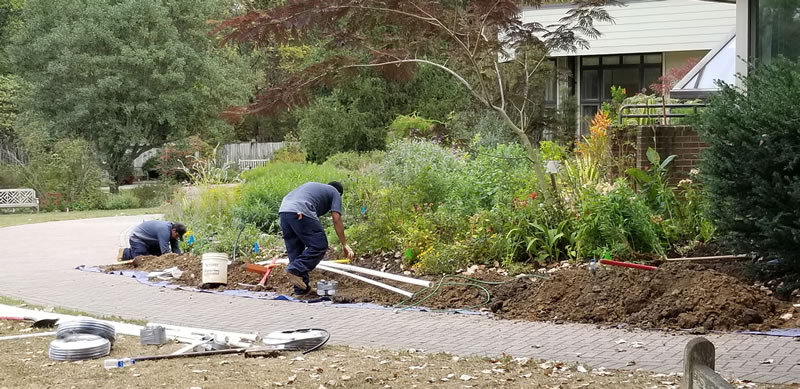 Smart water irrigation installation, 2019
It was so easy then… or it seems so now. As we look back from the vantage point of the year that changed everything, this rallying call from FROGS Talk in the last Gardenline of 2019 seems strangely prescient:
“Your support of public gardens like Green Spring plays an increasingly important role in nurturing resilience during change.”
 This anniversary retrospective is a mere snapshot of Green Spring’s first fifty years. Each decade of the park’s development has seen scores of notable changes and events. More importantly, each decade has seen scores of notable people who have left an indelible mark on this place: visionaries whose passion, dedication, and hard work (often unpaid) helped to shape it.
In 2003, Don Humphrey summed this up perfectly and his words hold true today:
“Many people have shared in making Green Spring’s dream a reality. Some of them were supporters in the early days. And there has been continuing and consistent support from the FCPA staff and our Mason District supervisor, Penny Gross. At the heart of the day-to-day operations are professional and dedicated permanent employees, doing what they like and doing it well. And we must not forget that somewhere out there in the gardens today is a seasonal employee and a volunteer keeping the dream alive. The seasonal isn’t being paid very much and the volunteer not at all. Tells you something right there.”

Photo credits: All photos from the Green Spring Garden photo archive.